


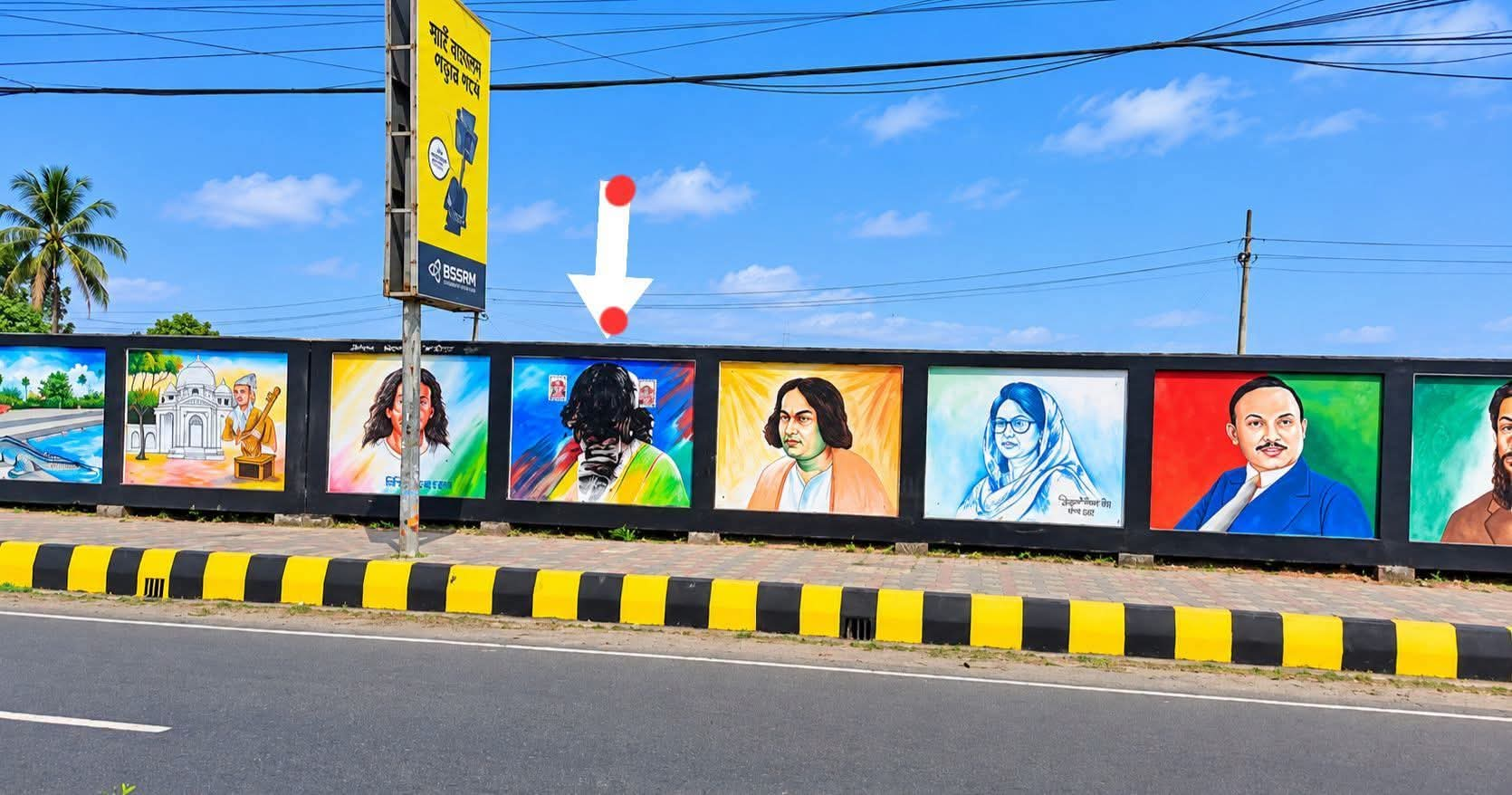
Unknown miscreants defaced a large graffiti portrait of Nobel laureate Rabindranath Tagore on the wall of Khulna Railway Station on Friday (6 November), covering the image with black ink. Two handwritten leaflets were pasted beside it.
Among a row of portraits of Bengali literary and historical figures, only Tagore’s was targeted.
The graffiti was painted by Khulna City Corporation as part of decorations for the visit of Prime Minister Tarique Rahman. It showed Tagore alongside Lalon Shah, SM Sultan, Kazi Nazrul Islam, Michael Madhusudan Dutt, and others associated with the region’s cultural history. Khulna Sadar police station officer-in-charge Lokman Hossain said the vandalism was noticed in the afternoon; most shops opposite the wall were closed that day, and the perpetrators have not yet been identified.
The leaflets carried the headline “Opposition to the Establishment of Dhaka University” and the slogan: “In Titumir’s Bengal, there is no place for the anti-Muslim and anti-East Bengal Rabindranath / No place for the worship of India.” The wording explicitly frames Tagore—a Hindu Bengali poet who spent most of his life in what is now India and whose work forms part of the shared Bengali literary heritage—as an enemy of Muslims and of “East Bengal.”
Khulna City Corporation administrator Nazrul Islam Manju condemned the act, saying the portraits were meant to encourage free thinking among children and young people, and that covering Tagore’s image with ink revealed “narrow-mindedness and sickness of mind.”
This is not an isolated incident. On 10 October, a Tagore graffiti in Dhaka was similarly defaced; police later arrested four people, including Al Nur Mohammad Ayash of the State Dialogue Forum.
Selective blackening of Tagore’s image, accompanied by leaflets that treat him as a symbol of “India worship” and hostility to Muslims, is a straightforward expression of anti-Hindu and anti-India prejudice. Tagore was not a political activist of the present day; he was a poet and thinker whose writings on humanism, nature, and Bengali culture have long been part of the literary inheritance of both Bengals. Targeting him on communal and anti-Indian grounds while leaving other portraits untouched shows the attackers’ motive is not artistic criticism or political disagreement but communal exclusion.
Such vandalism, and the ideology that justifies it, undermines Bangladesh’s own cultural claims. A society that cannot tolerate the image of one of the most important modern Bengali writers because of his Hindu background and Indian connections is not defending “Titumir’s Bengal”; it is shrinking the space for shared history and free expression. Police and civic authorities should treat the Khulna defacement with the same seriousness shown in the earlier Dhaka case.