


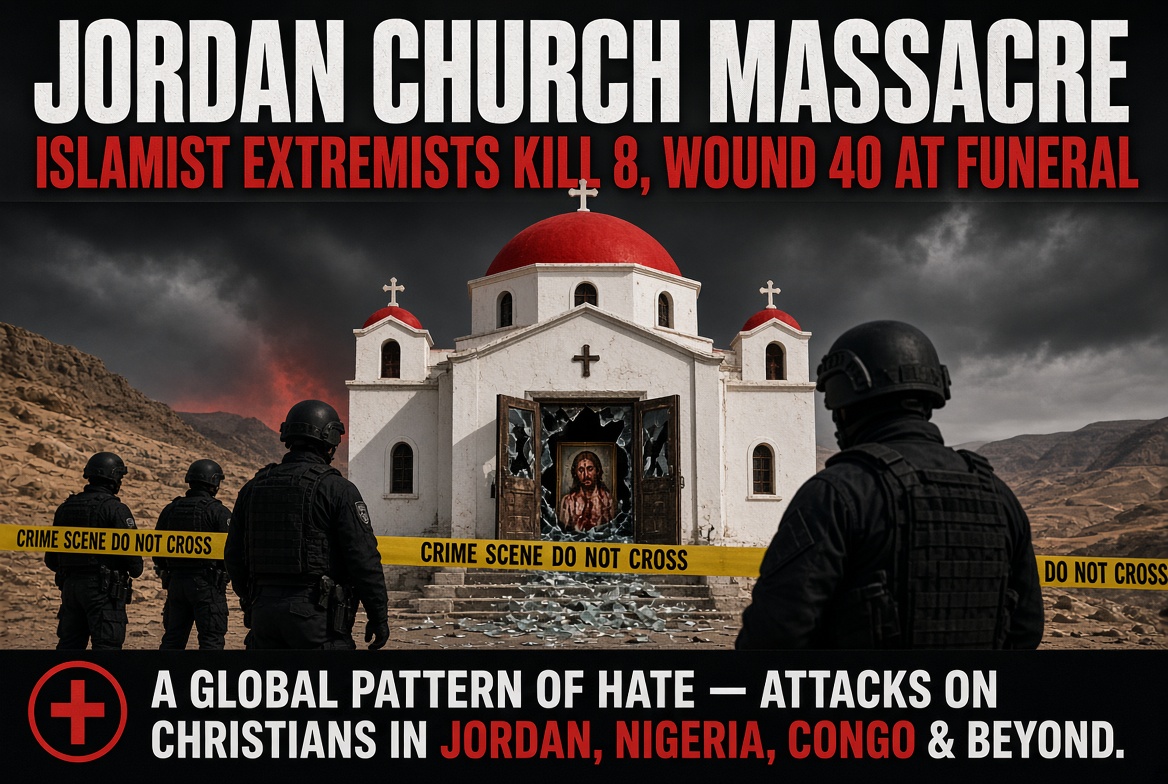
Prayer services had just begun at the Greek Orthodox Saint George’s Church in Karak governorate on Friday when lawyer Nasser al-Burqan heard what he first mistook for an exploding air conditioner. The sounds continued, and he realized gunmen were opening fire on mourners attending a funeral for a relative.
When the shooting stopped after several minutes, Burqan looked out a window and saw two of the attackers roughly two meters away: one masked, the other unmasked and armed with a handgun. “He pointed the handgun at me and opened fire,” Burqan said. Shattered glass cut his face and drew blood; he declined medical help, insisting he was fine. His son, also at the service, was later shot in the leg and hospitalized, Reuters reported.
Jordanian authorities described the attack as an act of extremist terrorism by a “group of extremists.” It killed eight people and wounded about 40, most of them from Jordan’s small Christian minority.
Prime Minister Jafar Hassan called it the product of “terrorist ideology and blind extremism.”
King Abdullah II vowed an “iron fist” response and said the perpetrators would face the harshest penalties.
Security has been heightened at malls, embassies, and other sites across the kingdom while the manhunt continues. No group has yet claimed responsibility, and officials say it is too early to confirm links to known networks, though Jordan has repeatedly foiled Islamist militant plots in recent years.
The assault is rare in relatively stable Jordan, yet it fits a broader, documented pattern of Islamist extremism and targeted violence against Christians and other non-Muslim minorities. In the Democratic Republic of Congo, the Islamic State-linked Allied Democratic Forces (ADF) has carried out repeated massacres, including an attack on a Christian funeral that killed around 100 people. In Nigeria, Islamist groups and armed militants have killed thousands of Christians and destroyed large numbers of churches over more than a decade. In Syria, a suicide bombing struck a Greek Orthodox church in Damascus in 2025. Similar patterns appear in parts of the Sahel, the Middle East, and beyond, where jihadist ideology frames non-Muslims as legitimate targets.
These attacks are often accompanied by online and offline hate campaigns that dehumanize Christians, Jews, and other groups, portraying them as enemies of Islam or obstacles to theocratic rule.
Open Doors and other monitors have recorded rising violence scores against Christians in sub-Saharan Africa and the Middle East, with churches, funerals, and worship services repeatedly singled out. While the vast majority of Muslims reject such violence, the persistence of Salafi-jihadist networks, recruitment, and ideological justification has produced a sustained global threat that authorities in multiple countries continue to confront.
In Karak, the attack has shocked a community long accustomed to coexistence. Jordan’s leadership has emphasized national unity and a firm security response. The episode nonetheless underscores the transnational reach of Islamist extremist ideology and the vulnerability of minority religious communities wherever it takes hold.