


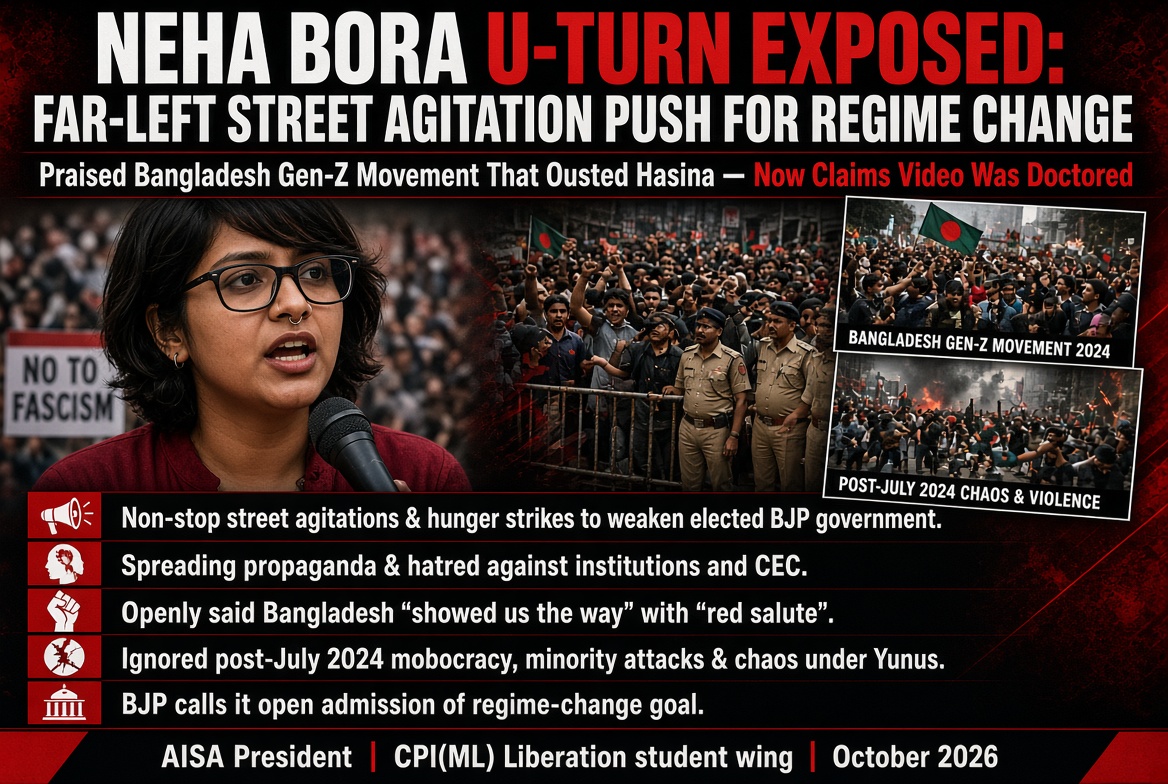
AISA national president Neha Bora, a leading face of ongoing youth protests in India, has walked back her open praise for Bangladesh’s 2024 Gen-Z-led movement after facing backlash.
In an interview with Nidhi Razdan, she asserted that a viral video in which she congratulated Bangladeshi activists and said their movement “showed us the way” had been doctored and taken out of context by the “right-wing IT cell” and “Godi media.”
She denied any call for violent overthrow of the Modi government, framing the clip as a message solely for the Socialist Student Front (SSF) conference congratulating progressive activists fighting authoritarianism and religious fundamentalism.
The original video, shared around 14 October 2026 and addressed in connection with Bangladesh’s student events, included the lines: “We present you with our red salute. And we know that the Gen-Z movement that we are seeing everywhere in this country first started in Bangladesh. And congratulations to you for showing us the way… We know that the movement that began in Bangladesh was for democratic and voter rights. Today the movement that the young people are participating in and leading is also a movement for democratic and voting rights… the fight that you fight against religious fundamentalism in your country is also a fight that the Gen Z and the young people of this country fight today.”
BJP leaders, including national spokesperson Pradeep Bhandari, described this as an “open admission” of a regime-change objective, linking it to the broader opposition ecosystem’s street campaigns.
Bora and her AISA colleagues (student wing of CPI(ML) Liberation) have been central to sustained street mobilisations in Delhi and elsewhere. These include a 23-day hunger strike earlier in 2026 (alongside Sonam Wangchuk and others) that contributed to the resignation of the education minister over exam paper leaks and education issues; repeated flash marches, barricade-climbing, and detentions demanding the resignation or impeachment of Chief Election Commissioner Gyanesh Kumar over the Special Intensive Revision (SIR) of electoral rolls; and claims of massive voter deletions framed as “vote chori.”
She has repeatedly vowed that the agitation continues until the CEC is removed and SIR is halted, while accusing the government and police of repression. Critics argue this pattern of non-stop street pressure, combined with narrative framing that equates Indian electoral processes and institutions with “authoritarianism,” aims to weaken the elected BJP government, generate sustained hatred toward it, and create conditions for extra-parliamentary change rather than ordinary political contestation.
The Bangladesh reference is particularly pointed. The 2024 anti-quota protests began after a court decision reinstating job reservations (including for descendants of 1971 freedom fighters) and escalated into widespread violence, a crackdown, Hasina’s resignation on 5 August, and her flight to India.
What followed under the Muhammad Yunus-led interim government included documented chaos, revenge attacks, and large-scale violence against minorities—particularly Hindus—with reports from minority organisations of over 2,000 incidents of attacks on homes, businesses, and places of worship in a short period after the ouster, plus broader law-and-order breakdowns, targeting of Awami League affiliates, and political instability. Yunus and his administration have faced ongoing accusations of selective accountability, economic difficulties, and failures to fully restore order or protect minorities, even as some official voices downplayed the communal dimension of the violence.
Bora’s framing of the episode primarily as an inspiring “progressive” struggle for democratic and voter rights, while downplaying or omitting the mobocracy, targeted communal violence, and subsequent governance problems, has drawn sharp criticism as selective and propagandistic.
In her clarification, Bora claimed the video was prepared for the SSF’s national conference and that right-wing accounts stripped identifying graphics to manufacture outrage. She argued that Indians have been “trained” by media and the right-wing ecosystem to react with automatic hatred at any mention of Bangladesh. Defenders of her position (including some fact-checks) maintain the remarks stayed within solidarity for student activism on rights issues and did not explicitly call for violence or a Bangladesh-style coup in India.
Opponents counter that equating the two situations, offering a “red salute,” and embedding the praise within an active campaign of continuous street protests and institutional delegitimisation against an elected Indian government reveals the practical intent: to import a model of mass agitation capable of forcing power shifts outside normal electoral channels.
Bora’s network continues to coordinate with other student and opposition-aligned groups on these agitations. The episode underscores a recurring pattern among certain left-student formations: sustained street mobilisation, expansive accusations of democratic erosion against the BJP, and selective international solidarity that highlights alleged Indian failures while soft-pedalling the documented costs—violence, minority targeting, and institutional fragility—of the Bangladesh precedent they invoke.