


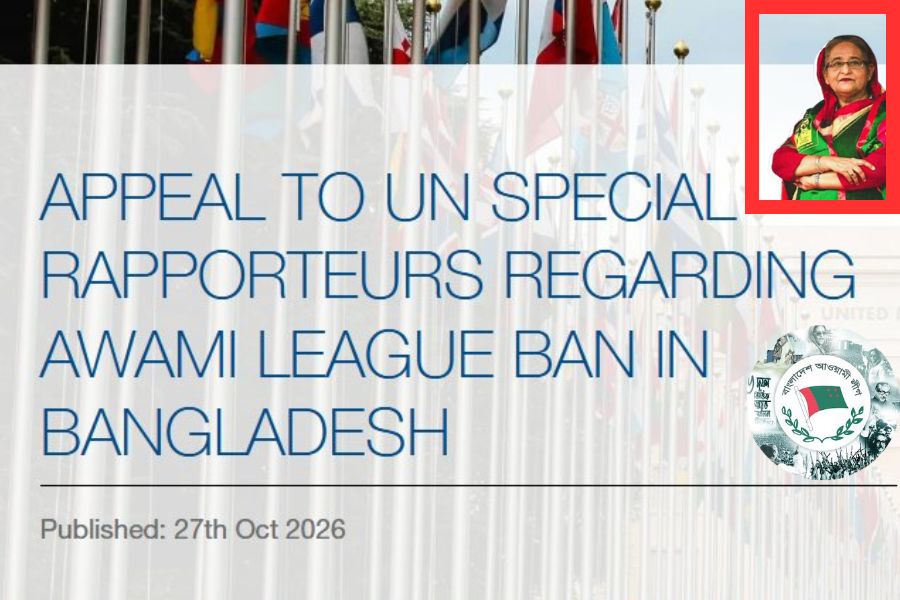
Awami League President and five-time prime minister Sheikh Hasina has submitted a formal communication to United Nations Special Rapporteurs challenging the ongoing ban on her party, arguing that it violates fundamental political rights and undermines democracy in the country.
The appeal, filed through London-based barrister Steven Powles KC of Matrix Chambers, contends that the ban—first imposed by the interim administration under Muhammad Yunus and later maintained and formalised by the Bangladesh Nationalist Party (BNP) government of Prime Minister Tarique Rahman—disenfranchises a significant portion of the population. It notes that the BNP came to power in the February 2026 elections in which the Awami League was barred from participating, describing those polls as neither free, fair, nor inclusive and questioning their legitimacy.
According to the communication, the prohibition places Bangladesh in a constitutionally untenable position by attempting to consolidate democratic government while a major political party and its affiliates remain legally blocked from electoral participation. It highlights practical difficulties in challenging the ban domestically, citing the restrictions themselves and reported attacks on Awami League supporters that have complicated efforts to instruct lawyers.
The submission alleges violations of key provisions of the International Covenant on Civil and Political Rights, specifically Article 19 (freedom of expression), Article 21 (freedom of peaceful assembly), Article 22 (freedom of association), and Article 25 (political rights).
It argues that the ban is not prescribed by law in a legitimate sense—having been imposed by a government that itself took office following flawed elections—lacks a legitimate aim, forms part of broader attacks on Awami League members and associates, is disproportionate, and lacks adequate safeguards.
Hasina’s representatives have called on the Special Rapporteur on the Promotion and Protection of Human Rights While Countering Terrorism, the Special Rapporteur on the Rights to Freedom of Peaceful Assembly and of Association, and the Independent Expert on the Promotion of a Democratic and Equitable International Order to take urgent action. They have specifically urged the issuance of a public statement calling for free, fair, and inclusive elections in Bangladesh.
The appeal follows earlier international outreach. In 2025, UN experts had already raised concerns with the interim government over the party ban, restrictions on speech and assembly, mass arrests, and fair-trial issues related to International Crimes Tribunal proceedings. The Awami League was banned from political activities in May 2025 under anti-terrorism legislation pending those trials, and its registration was suspended by the Election Commission. Hasina, who was to India after the August 2024 student-led uprising, has faced a death sentence in absentia for alleged crimes against humanity linked to the crackdown on protesters.
Background context includes the July–August 2024 protests that forced Hasina’s fall after 15 years in power, during which a UN fact-finding report attributed widespread human rights violations, including hundreds of deaths, to her government and security forces. The Yunus administration later facilitated elections that excluded the Awami League; the BNP secured a majority, with Tarique Rahman (son of the late Khaleda Zia) becoming prime minister in February 2026. The new government has upheld the ban, and reports have continued of detentions and other pressures on the Awami League figures.
As of this writing, there has been no immediate public response from the Bangladeshi government or the UN Special Rapporteurs. The communication adds to a series of legal and diplomatic efforts by Hasina and Awami League representatives since 2024, including prior urgent appeals regarding the ban and fair-trial concerns, as well as a 2025 letter urging the UN Development Programme to suspend electoral assistance.
Critics of the ban, including some human rights observers and figures such as exiled writer Taslima Nasreen, have described the exclusion of a major historical party as damaging to political pluralism. Supporters of the measure have pointed to accountability for the 2024 violence and the need for transitional justice.