


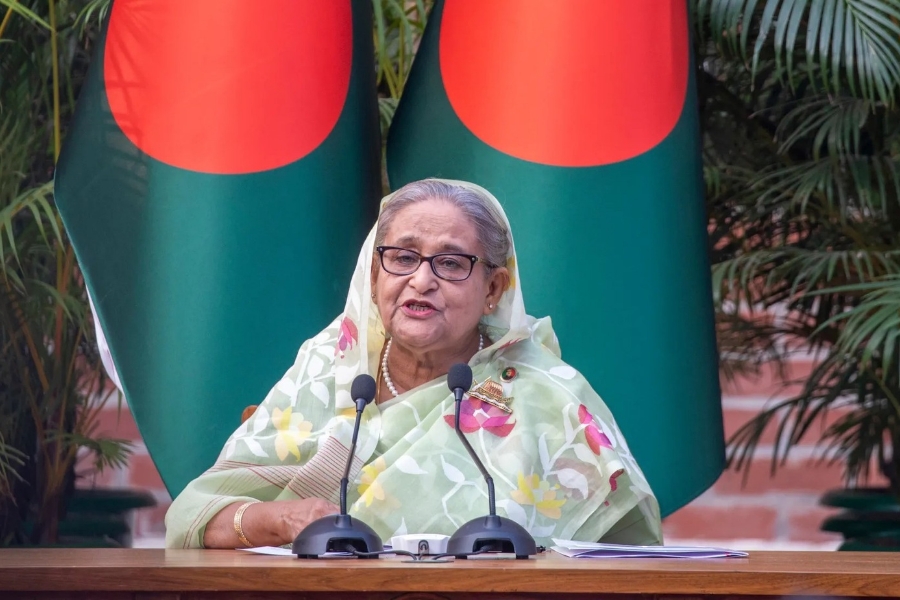
The Awami League is circulating a draft petition among British politicians seeking diplomatic support for what it calls independent justice, safeguards for its leader Sheikh Hasina, and a process of political reconciliation in Bangladesh. The effort aims to facilitate her possible return after she was ousted in the 2024 mass uprising and later sentenced to death in absentia.
A draft obtained by TIMES of Bangladesh has been shared with prospective signatories. It urges the UK Secretary of State for Foreign, Commonwealth and Development Affairs to lead a coordinated diplomatic initiative addressing what the petition describes as the politicisation of justice.
It calls for written assurances that Hasina would not face execution, torture or other harm if she returns; an independent judicial review of her conviction and death sentence; access to lawyers of her choice; an independent investigation into the proceedings; and international monitoring involving the UN human rights office (OHCHR).
It also asks the UK to facilitate inclusive dialogue among political parties, victims and civil society, and for the UK High Commission in Dhaka to engage relevant parties, with a written response requested within 14 days.
According to Awami League leader Habib Millat, six British politicians have signed so far: Bob Blackman MP, former MEP Charles Tannock, MSPs Martyn Day, Paul McLennan and Alan Brown, and Seamus Logan MP. The draft states that Hasina intends to return around December 2026, though timing and arrangements remain uncertain, and argues that diplomatic engagement is needed beforehand.
Signatories express concern that proceedings could be used for political retaliation and question the trial’s fairness, while noting that Hasina and Awami League leaders should cooperate with independent investigations, respect lawful processes, and refrain from violence or incitement.
A former diplomat familiar with similar efforts said the impact of such petitions depends heavily on bilateral relations. “Put simply, national interest prevails,” the diplomat noted, adding that petitions carry little weight when ties are strong but may be used to raise questions when relations are strained.
Bangladesh has faced comparable petitions before; Dhaka has typically not replied formally in writing but has privately told the foreign government concerned that the opposition’s claims were unfounded.
These moves come against the backdrop of Hasina’s latest statements to the Associated Press. In an email interview (questions submitted the previous week; answers received around 5 November 2026), the former prime minister (2009–2024) reiterated her plan to return from exile in India in December, a commitment she first announced in August.
“If death is my destiny, I would rather die on the soil of my own country, among my own people,” she told the AP. “So, I will return to Bangladesh. That decision has not changed.” She said she was fully aware of the risks: “I know that I may be arrested when I return. I may be imprisoned, tortured or even killed. … But I cannot spend the rest of my life watching my people suffer from a distance.” She did not disclose her planned route or method of return.
Asked whether she expected the United States, India or others to pressure Bangladesh for her safe return, Hasina replied that she was not seeking foreign protection. “I value friendship and cooperation with all nations. That has always been our (Bangladesh’s) foreign policy. But I do not need the blessing of a foreign power to return to my own country.”
Hasina, who has denied wrongdoing in the 2024 crackdown, rejected the tribunal’s verdict and the trial’s legitimacy. She also rejected the OhCHR report which claims 1,400 deaths during anti-government tests.
She alleged ongoing repression of the Awami League (which remains banned and was barred from the February 2026 election won by Tarique Rahman under the interim administration led by Muhammad Yunus): at least 20,000 party members killed since August 2024, with thousands more arrested, tortured or in hiding, and supporters losing homes, businesses and livelihoods.
“There is no normal political or democratic environment,” she said, accusing the authorities of systematic suppression. She also voiced concern about the growing influence of hard-liners.
Bangladesh has repeatedly sought her extradition under its treaty with India; New Delhi has declined. A junior foreign affairs minister was quoted as calling her a “terrorist” and “fugitive” and insisting she would be handed over, while dismissing suggestions she would need travel documents.
The prime minister’s office did not respond to an AP request for comment. Rights groups, including Human Rights Watch, have criticised aspects of the current government’s handling of civil and political rights; the government has said arrests involve specific charges.
The petition’s call for foreign diplomatic safeguards thus sits alongside Hasina’s public insistence that she needs no foreign “blessing” to return, while her party continues to seek international engagement on justice and security guarantees ahead of any homecoming.