


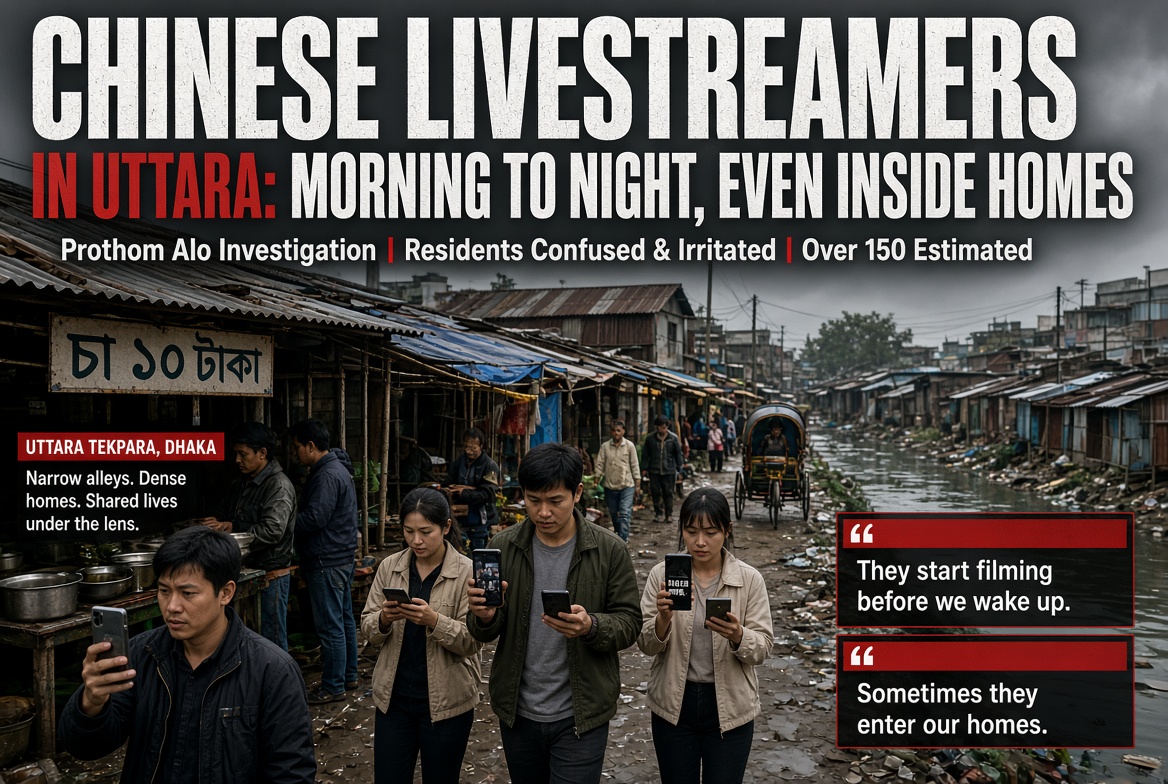
A group of Chinese nationals has been livestreaming for months from morning until night in Sector 12 of Uttara and the adjacent Tekpara area of Dhaka, sometimes entering residents’ homes, according to an investigation by Prothom Alo.
Local residents estimate that more than 150 Chinese nationals are involved. They typically carry two mobile phones—one used for livestreaming and the other displaying text—and walk the streets and alleys of the densely populated, low-income neighbourhood beside a canal. What began as curiosity among residents has turned into irritation.
“It would be understandable if this were just a matter of a day or two. But they have been making these videos for months. They start filming before we even wake up. When we go to bed, we still see them filming. But we have no idea what they do with these videos,” Akram Hossain, a Tekpara resident, told Prothom Alo.
Prothom Alo reporters visited the area on 27 October and 3 November and attempted to speak with local residents and 17 Chinese nationals. Most of the Chinese nationals declined to talk or cited language barriers. A Bangladeshi guide named Ritu Akhter, who said she and other women earn Tk 700–800 a day assisting them, facilitated a conversation with one Chinese national, Fangyou. He stated via Google Translate that they livestream on WeChat as part of product promotion activities but refused to explain why they had chosen the area or why they filmed continuously.

Ritu Akhter told the newspaper that the Chinese nationals earn money by posting on WeChat, Douyin (TikTok), and other platforms, and that they specifically target low-income neighbourhoods.
Translations of livestream commentary—verified by four Bangladeshis who understand Chinese—show that the Chinese nationals repeatedly claim they are broadcasting from New Delhi, India. On 1 November, a woman named Mianmian, who said she was from Sichuan province, stood beside the canal and told viewers: “This is New Delhi. Their homes are extremely dirty. There isn’t even a fan inside the tin-roofed houses. This place is quite underdeveloped, dirty and unhygienic, and the law-and-order situation is poor.” She also described toilet use in India.
At local tea stalls, a Chinese national named Wang Wei said viewers were watching “cow urine tea” and claimed the tea was made with dirty river water, describing local lifestyles as extremely unhygienic. Others portrayed Bangladeshis as poor people living in dirty, damp conditions or said Bangladeshi men misuse money. Some Chinese women claimed they lived in the area with husbands and families after marrying in India.
Not all commentary was negative. One Chinese national, Li Yang, pointed out air conditioners in buildings and noted that many were Chinese-made, offering a prize for correctly guessing a brand.
Residents have raised privacy concerns. Rozina Khatun said Chinese nationals sometimes enter homes while people are not properly dressed and begin filming. Papia Begum reported that some have entered bathrooms: “Even if we say something to them, they don’t understand. They just smile, say sorry and leave. This kind of nuisance continues throughout the day.”
Local police have not monitored the activity closely. Mohammad Khalid Mansur, officer-in-charge of Uttara West Police Station, told Prothom Alo he did not know why the videos were being made or where they were shown, but said he had informed senior authorities and that “work is underway on the matter.” Language barriers and the Chinese nationals’ reluctance to engage have limited further inquiry, police said.
The Prothom Alo report, published on 6 November 2026 by Abdullah Al Mamun, highlights the absence of clear oversight as the livestreaming continues in the neighbourhood. Similar activity by Chinese nationals filming in the same area had been reported earlier in 2026 by other outlets, including The Business Standard.