


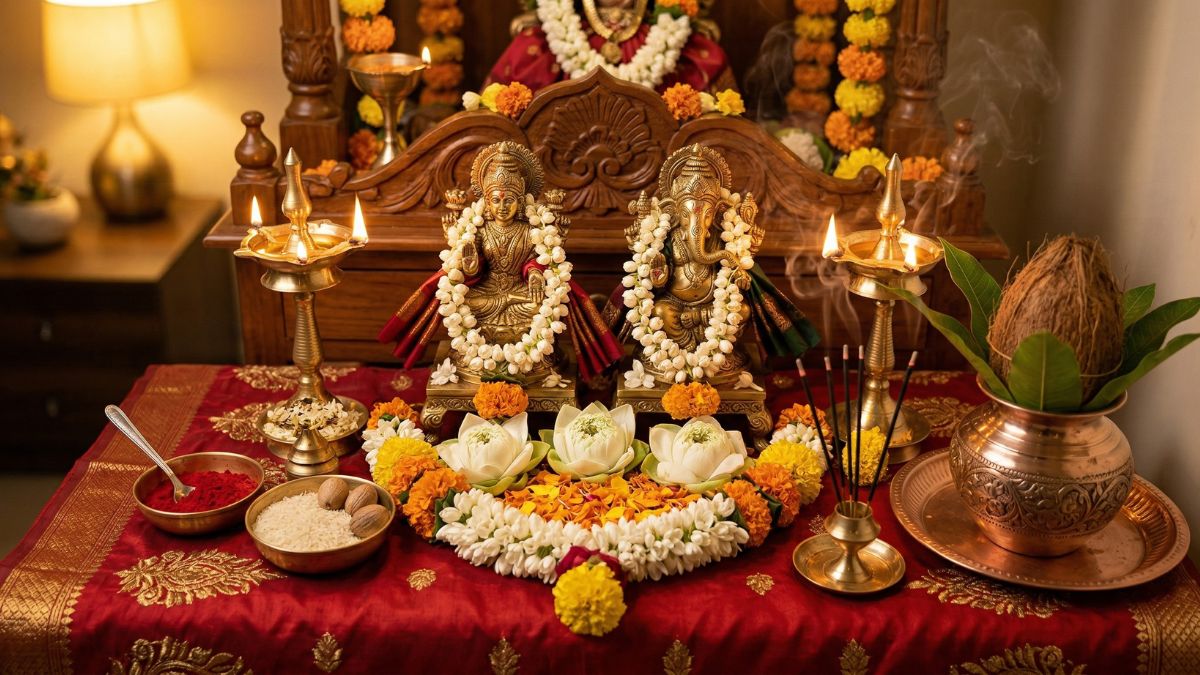
Bengali Hindus across Bangladesh are marking Kojagari Lakshmi Puja today, the first full-moon night after Durga Puja, worshipping the goddess of wealth, prosperity, and auspiciousness in homes and community gatherings. According to the Vishuddha Siddhanta Panjika, the Purnima tithi began around midday on October 25 and continues into the following morning.
Households prepare with traditional elements—mangal ghat, rice-flour alpana footprints of Lakshmi, sindur, paddy, mango leaves, tulsi, and night-long vigil—while many women observe fasts. The festival, also observed by some on Thursdays or Dipanwita Amavasya in certain regions, underscores longstanding cultural practice among the community.
Yet the celebrations unfold against a backdrop of sustained violence against religious minorities—primarily Hindus, but also Buddhists and Christians—since the political upheaval of August 2024 that ousted Sheikh Hasina.
Even in the just-ended Durga Puja celebrations, idols were vandalised in 34 places across the country, while radical Islamists arranged a beef party beside the Hindu temple at JagannathUniversity,y and a Muslim man was caught burning a Quran at a puja pavilion in Jhenaidah.
On the other hand, some radical Islamist clerics issued fatwas before the Durga Puja, asking Muslims not to visit Puja pavilions and not to wish the Hindus. They stated that it will make the Muslims kafir, fasek, and munafik.
Rights groups, led by the Bangladesh Hindu Buddhist Christian Unity Council, have documented thousands of incidents of killings, sexual violence, arson, looting, land grabbing, and attacks on places of worship. One widely cited tally recorded 2,442 incidents from August 4, 2024, to June 30, 2025, including murders, rapes, and temple desecrations, with the bulk concentrated in the chaotic weeks immediately after the transition.
Subsequent reports have cited more than 2,000–2,700 incidents overall, dozens of killings (including high-profile mob lynchings such as that of garment worker Dipu Chandra Das), nearly 100 attacks on places of worship, and ongoing cases into 2025–2026. In the first half of 2026 alone, the Unity Council reported 257 incidents involving deaths, temple attacks, and other violence; broader tallies for 2025 pointed to hundreds more, with murders, sexual assaults, and property destruction.
Buddhists, particularly indigenous communities in the Chittagong Hill Tracts, have also faced targeted violence, including vandalism and looting of temples and the cancellation of major festivals amid insecurity and clashes with settlers. Christian and Ahmadiyya sites have been hit as well.
Many early attacks involved mobs moving with apparent impunity, chanting anti-minority slogans, while later incidents have included arson of homes and businesses, assaults linked to blasphemy rumors or personal disputes framed communally, and systematic property seizures.
A core grievance is the near-total lack of accountability. Under the Muhammad Yunus-led interim government, authorities frequently denied or minimized the communal character of the violence, labeling many cases as politically motivated or ordinary crime, and acknowledged far fewer incidents than rights groups.
Only a small fraction of reported cases led to formal FIRs, arrests, or prosecutions; convictions remained rare. Police verification of large numbers of incidents often resulted in mere complaints rather than criminal cases.
This pattern of impunity has persisted into the period after the February 2026 elections that brought the Bangladesh Nationalist Party (BNP) under Prime Minister Tarique Rahman to power. While the new administration has publicly pledged equal rights and security for all citizens regardless of faith—“Religion is personal, but the nation belongs to everyone”—and deployed thousands of personnel, vehicles, and resources to protect roughly 33,800–33,900 Durga Puja venues this October, resulting in a notably quieter major festival compared with 2024–2025, underlying vulnerabilities remain.
Pre-Puja idol vandalism and temple attacks were still recorded in multiple districts, and broader monthly and half-year tallies of minority-targeted incidents have continued.
Critics argue that festival-specific security, while welcome, does not address year-round protection, investigation of past cases, or the perception that perpetrators face little consequence.
Official accounts have at times cited lower figures—such as hundreds of “incidents involving minorities,” of which only a minority were deemed communal—highlighting the sharp divergence between government data and independent monitoring.
Rights advocates and minority leaders maintain that the failure to pursue justice systematically has emboldened attackers, deepened fear (including reluctance to report or even access public services), and contributed to displacement and economic hardship for affected families. International observers, including reports referencing UN and EU asylum assessments, have noted the post-2024 surge and accountability gaps.
As Hindus light lamps and keep vigil for Lakshmi tonight, community voices continue to call for consistent law enforcement, thorough investigations, and an end to the climate in which attacks on religious minorities can occur with effective impunity. The contrast between festival security measures and the longer record of unpunished violence remains a central test for Bangladesh’s post-2024 political order.