


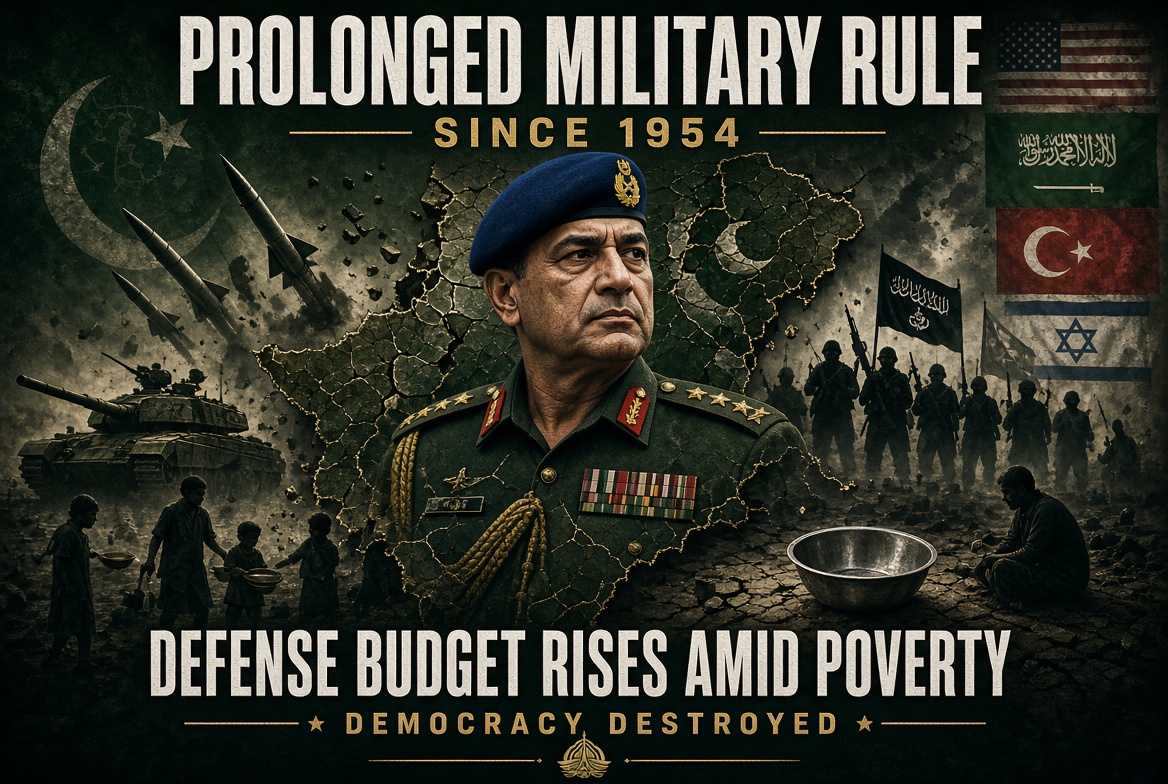
Pakistan’s de facto ruler, Field Marshal Asim Munir, is advancing a plan to carve the country’s four provinces into as many as 12, 15, or even 160 smaller, weaker units. Presented as an administrative fix for unwieldy provinces and poor governance, the proposal is a classic divide-and-rule maneuver by a military establishment that has dominated the state since the mid-1950s, systematically undermined elected governments, and prioritized its own power, foreign patrons, and selective militant tools over democracy and public welfare.
The pattern began early. General Ayub Khan entered the cabinet as defence minister in 1954, blurring civil-military lines before the 1958 coup that imposed the first prolonged martial law. Subsequent interventions—Yahya Khan (1969–71), Zia-ul-Haq (1977–88), and Musharraf (1999–2008)—installed direct military rule for roughly three decades.
Between coups, the army retained decisive control over security, foreign policy, and budgets, ensuring no civilian prime minister has completed a full five-year term.
The result has been repeated constitutional suspensions, engineered elections, judicial manipulation, and the sidelining of parties that resist military preferences.
Munir has accelerated this trajectory: constitutional changes extended service chiefs’ tenures, formalized his command over the armed forces until 2030 with lifetime rank and immunity, and tilted the “hybrid” system toward open military primacy without the need for a classic coup.
Large provinces—Punjab (dominated by the PML-N) and Sindh (PPP stronghold)—have long served as limited counterweights to the centre, preserving pockets of alternative power even under dictators. Splitting them into miniature units, likely overseen by elected but pliant chiefs, district assemblies, or nominees of “the government” (effectively Munir), would shrink these bases of opposition and further centralize authority in Rawalpindi.
Critics note the timing coincides with Munir’s consolidation after the disputed 2024 elections and ongoing pressure on Imran Khan’s PTI. The stated goals of better services and growth ring hollow amid chronic weak institutions, high debt, and stagnant development spending.
This domestic power grab occurs while the military deepens subservience to external patrons. Decades of US security assistance and intelligence cooperation during the Afghan wars gave way to continued alignment with Washington’s priorities.
Pakistan has long supplied troops and expertise to Saudi Arabia; recent bilateral and trilateral arrangements with Riyadh and Turkey (the 2025 Strategic Mutual Defence Agreement and the 2026 Mecca Joint Defence Agreement) formalize mutual defence commitments, joint training, intelligence sharing, and potential rapid deployments—without meaningful parliamentary scrutiny.
These pacts, involving nuclear-armed Pakistan’s capabilities alongside Gulf financing and Turkish industry, position the military as a regional security contractor while securing loans, deposits, and investment that prop up the budget.
Official policy maintains non-recognition of Israel and support for a Palestinian state, yet the army’s history of selective cooperation (including past intelligence and arms channels during the Afghan jihad) and current mediation roles in US-Iran talks illustrate a pragmatic, interest-driven posture that subordinates domestic priorities to external alignments.
Equally entrenched is the military’s long-standing patronage of jihadist groups as instruments of policy. Through the ISI, the army has trained, armed, sheltered, and directed outfits such as the Afghan Taliban (and Haqqani network), Lashkar-e-Taiba, Jaish-e-Mohammed, and others for use against India in Kashmir and influence in Afghanistan.
High-profile attacks—the 2008 Mumbai massacre, Pulwama, and others—have been linked to these networks operating from Pakistani soil, even as the state received Western counter-terrorism funds.
Recent reporting continues to describe army/ISI facilitation of training camps, funding, and political cover for designated groups, while selective operations target only those (such as the TTP or Baloch insurgents) that turn against the state. This dual track—crushing internal threats while preserving external proxies—has exported instability, fuelled domestic radicalisation, and imposed heavy human and economic costs on ordinary Pakistanis.
The fiscal consequences are stark. For FY 2026–27 the government proposed roughly PKR 3 trillion for defence (an ~18% rise), plus separate military pensions (~PKR 822 billion) and development programme funds, while overall development spending remained constrained around PKR 1 trillion in nominal terms—a real cut. Weapons procurement rose sharply.
This occurs as World Bank data show poverty trapping around 120 million people (nearly half the regional extreme-poor total in MENAAP), with growth too slow to lift incomes substantially and the country accounting for a disproportionate share of extreme poverty despite facing no active conventional war on its soil. Debt interest dominates the budget; IMF-driven austerity squeezes welfare and infrastructure while the military budget expands.
The Special Investment Facilitation Council, co-chaired by Munir and staffed with serving officers, has failed to deliver promised foreign investment, underscoring how security-first priorities crowd out public goods.
Munir’s provincial redesign is therefore not an isolated administrative experiment. It is the latest expression of a military system that has, since the 1950s, treated democracy as dispensable, foreign patrons and selective jihadist tools as strategic assets, and rising defence outlays as non-negotiable even as poverty deepens. Smaller provinces would further reduce residual checks, leaving ordinary Pakistanis with still weaker institutions, higher security costs, and fewer avenues for accountable governance.
For the country’s long-term stability, the field marshal would be better advised to reverse course than to refine the art of divide-and-rule.