

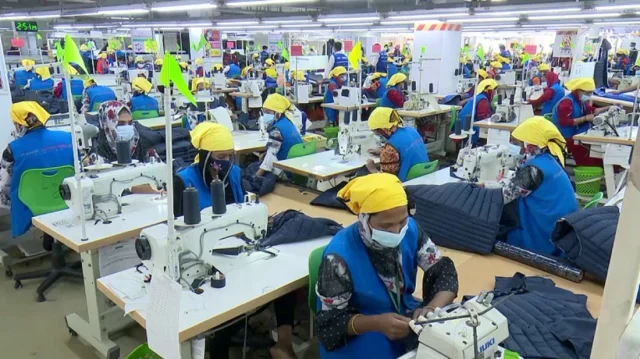
Bangladesh’s garment exports to the European Union (EU) continued to decline in the first eight months of 2026, even as the region’s apparel import market showed signs of recovery. While China strengthened its position as Europe’s leading clothing supplier and Vietnam increased its exports, Bangladesh struggled with falling shipment volumes and lower prices.
According to January–August 2026 data from Eurostat, compiled by Bangladesh Apparel Voice (BAV), EU member states imported apparel worth €60.29 billion from countries around the world. This represented a 3.83 percent decline in import value compared with the same period last year. Import volumes fell by 2.57 percent, while the average price per kilogram of clothing dropped by 1.29 percent.
Bangladesh’s apparel exports to the EU were valued at €11.93 billion during the period, down 11.67 percent from €13.50 billion a year earlier. The decline represents a loss of €1.57 billion in export earnings over eight months.
European Apparel Market Recovers, but Uncertainty Remains
BAV’s analysis shows that the European apparel import market experienced a significant downturn at the beginning of 2026. Between January and April, imports fell by approximately 10 percent year-on-year, with January alone recording a 15.48 percent decline.
Conditions began to improve in May. Between May and August, EU apparel imports increased by approximately 2.6 percent compared with the same period in 2025. This recovery helped narrow the overall decline in imports to 3.83 percent for the first eight months of the year.
Last year, the EU’s apparel imports increased by 2.1 percent to €90 billion, while the European economy grew by 1.5 percent. During that period, Chinese garment exporters expanded their shipments to Europe amid increased US tariffs on Chinese goods. As a result, China’s apparel export volume to the EU rose by 11.64 percent.
The surge in Chinese shipments contributed to high inventory levels among European retailers entering 2026, reducing the need for fresh orders early in the year.
At the same time, rising energy prices linked to conflict in the Middle East put additional pressure on household purchasing power. Inflation and weakening consumer confidence prompted retailers to reduce new orders.
However, relatively strong retail sales during the European spring season helped revive purchasing activity. Imports also increased between June and August as retailers prepared for autumn and winter demand. Some shipments delayed earlier in the year arrived during this period, contributing to the recovery.
Despite these improvements, the European apparel market has yet to fully overcome its challenges.
Lower Garment Prices Deepen Bangladesh’s Export Slump
Bangladesh experienced declines in both apparel export volumes and average prices in the EU market.
Between January and August, the volume of clothing imported from Bangladesh fell to 866.76 million kilograms, a 4.58 percent decrease from the same period last year.
More significantly, the average price per kilogram dropped by 7.43 percent to €13.76.
According to BAV’s analysis, falling prices were a major factor behind the sharp decline in Bangladesh’s export earnings. Although shipment volumes decreased, lower unit prices contributed substantially to the reduction in export value.
Bangladesh also lost ground in terms of its share of the EU apparel import market. Its share of total import value fell from 21.5 percent in January–August 2025 to 19.8 percent in the same period this year.
The downturn was particularly severe at the beginning of 2026, when Bangladesh’s garment exports declined by 19 percent during the first two months. Although conditions improved afterward, export earnings remained significantly below last year’s level.
China Controls Nearly One-Third of the EU Apparel Market
China strengthened its position as the EU’s largest apparel supplier during the first eight months of 2026.
Chinese garment exports to the bloc reached €19.71 billion, marking a 2.38 percent increase compared with the same period in 2025.
China was the only major supplier to record growth in both export value and volume. Its share of total EU apparel imports increased from 30.7 percent to 32.7 percent, giving it nearly one-third of the market.
Vietnam also performed well, exporting €3 billion worth of apparel to the EU, up 4.46 percent year-on-year. The average price of Vietnamese garments increased by 10.11 percent, suggesting that the country benefited from higher unit values as well as stronger export earnings.
Pakistan recorded a 3.82 percent increase in apparel export volume, but its average prices fell by 12.96 percent. At €10.88 per kilogram, Pakistan had the lowest average garment price among the major suppliers.
Meanwhile, apparel exports to the EU from Türkiye, India, Sri Lanka and Indonesia each declined by approximately 11 percent.
The contrasting performances highlight the growing competitive pressure on Bangladesh, particularly as China expands its market share and Vietnam combines export growth with rising garment prices.
Competition Could Intensify in 2027
The European Commission’s Spring 2026 Economic Forecast projected that the EU economy would grow by 1.1 percent in 2026 and accelerate to 1.4 percent in 2027. Inflation was forecast to decline to 2.4 percent.
However, these projections depend partly on energy prices remaining stable. A prolonged conflict in the Middle East could push up energy, shipping and insurance costs, placing additional pressure on European businesses and consumers.
According to the European Commission, the conflict could reduce EU economic growth in 2026 by 0.3 percentage points.
Consumer spending has also faced pressure from social unrest and the rising cost of living. BAV’s report noted that approximately 1,500 shops were damaged during nationwide protests over the cost of living in France on October 17. Average sales at clothing stores fell by 14 percent that day. Protests were also reported in Belgium, Italy and Portugal.
If Christmas shopping fails to meet retailers’ expectations toward the end of the year, European buyers could reduce apparel orders in early 2027. Such a development would create further difficulties for Bangladeshi garment manufacturers and exporters.
Potential changes to the EU’s Generalised Scheme of Preferences (GSP), scheduled to take effect in January 2027, could also have significant implications for Bangladesh. Plans for a free trade agreement between India and the EU represent another important development to watch.
Changes in trade preferences and market access could reshape competitive conditions in Europe, potentially putting Bangladesh under greater pressure to maintain its position.
Bangladesh Needs to Move Beyond Volume-Driven Growth
Mohiuddin Rubel, a former director of the Bangladesh Garment Manufacturers and Exporters Association (BGMEA) and founder and chief executive officer of Bangladesh Apparel Voice, told Bangla Tribune that the European apparel market was showing gradual signs of recovery, but Bangladesh’s exports remained under pressure.
He said the sharp decline in average selling prices had contributed significantly to the fall in export earnings. Bangladesh, he argued, could not rely solely on increasing shipment volumes and needed to focus more on value addition and the production of higher-priced garments.
Rubel also pointed to China’s growing exports and Vietnam’s strong performance as evidence of intensifying competition in the European market.
At the same time, he warned that energy prices, transportation costs and uncertainty among European buyers could affect Bangladesh’s export prospects in the coming months.
He stressed the importance of strengthening long-term relationships with buyers, diversifying product offerings, improving production capacity and ensuring timely deliveries.
Rubel further noted that potential changes to European trade policies in 2027, along with a possible free trade agreement between India and the EU, could introduce new competitive challenges for Bangladeshi exporters.
He urged the industry to monitor market developments closely while improving product quality, productivity and overall competitiveness. Bangladesh should also build on its established manufacturing expertise and supply-chain capabilities to protect and strengthen its position in Europe.
Outlook: Recovery in Europe, but Mounting Pressure on Bangladesh
Although the EU apparel import market has begun to recover from its early-year downturn, Bangladesh’s export performance remains weak.
China’s expanding market share, Vietnam’s export growth and declining prices for Bangladeshi garments are creating a difficult competitive environment for the country’s apparel industry.
The immediate challenge is not simply to restore export volumes but also to improve unit prices, increase value addition and maintain competitiveness as European demand and trade policies evolve.
With potential changes to EU trade preferences approaching in 2027, Bangladesh’s ability to adapt its product mix, strengthen buyer relationships and improve productivity will be crucial to maintaining its position in one of its most important export markets.