


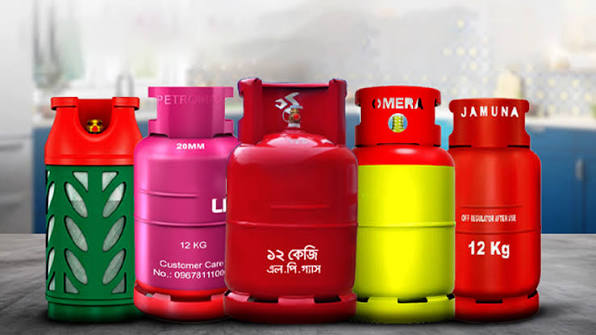
Weak market monitoring, concentrated market power, and import bottlenecks raise questions about the regulation of the country’s LPG sector
Amid widespread complaints that liquefied petroleum gas (LPG) is unavailable at government-fixed prices, another round of price adjustments is being considered in Bangladesh.
On October 29, the Bangladesh Energy Regulatory Commission (BERC) will hold a public hearing on proposals to revise LPG prices, including increases in charges and profit margins at the bottling, distribution and retail stages.
The proposed increases come despite BERC’s recent decision to raise the price of a 12-kilogram LPG cylinder by Tk 252, setting the price at Tk 1,837 on October 4. Importers, distributors and retailers, however, remain dissatisfied with the existing rates.
Recently, distributors and retailers called a two-day nationwide strike over their grievances, prompting the government to hold discussions with industry representatives. At the meeting, the government assured them that their demands would be considered.
Under its regulatory framework, BERC cannot increase LPG bottling charges or the margins of distributors and retailers without holding a public hearing. It has therefore invited the relevant parties to submit proposals for consideration.
Proposed Increases in Bottling, Distribution and Retail Charges
LPG companies have proposed raising bottling charges from Tk 15–16 per kilogram to Tk 25–30 per kilogram.
They have also proposed increasing distributors’ charges from Tk 4.17 to Tk 8.33 per kilogram and retailers’ charges from Tk 3.75 to Tk 10 per kilogram.
Separately, distributors have proposed raising their charge per 12-kilogram cylinder from Tk 50 to Tk 150, while retailers have proposed increasing their charge from Tk 45 to Tk 70 per cylinder.
According to a public notice issued by BERC, the October 29 hearing will consider proposals to revise consumer-level prices for both government-supplied and privately marketed LPG. The hearing will cover proposed changes to storage and bottling charges for private LPG, distribution charges and retail charges.
BERC said LP Gas Limited had submitted a proposal to revise the consumer-level price of government-supplied LPG. Several private companies holding LPG storage and bottling licences had also submitted proposals to revise storage, bottling, distribution and retail charges, as well as consumer prices. Several licensed LPG distributors have separately proposed changes to distribution charges.
The public hearing has been arranged to consider these submissions.
Another Price Adjustment Sought Within Weeks
On October 4, BERC increased the price of a 12-kilogram cylinder of privately marketed LPG by Tk 252, fixing it at Tk 1,837. The price had stood at Tk 1,585 in September.
The price of autogas, used in vehicles, was also raised from Tk 73.09 to Tk 84.62 per litre.
The regulator set the following prices for other cylinder sizes:
- 12.5 kg: Tk 1,913
- 15 kg: Tk 2,296
- 16 kg: Tk 2,449
- 18 kg: Tk 2,755
- 20 kg: Tk 3,061
- 22 kg: Tk 3,367
- 25 kg: Tk 3,827
- 30 kg: Tk 4,592
- 33 kg: Tk 5,051
- 35 kg: Tk 5,357
- 45 kg: Tk 6,888
A BERC official said the regulator was proceeding with the hearing in response to applications submitted by licence holders.
“The fact that we are holding a hearing does not automatically mean that prices will increase. We will listen to their demands and arguments. The hearing is being held to allow everyone to express their views,” the official said.
However, the repeated requests for price revisions raise broader questions about the effectiveness of market oversight, the transparency of price-setting mechanisms and the extent to which consumers are protected from excessive or arbitrary increases.
Business Strike Withdrawn After Hearing Announced
On October 12, the LPG Business Cooperative Association announced a two-day nationwide shutdown of gas cylinder shops in protest against alleged harassment of LPG traders.
Association president Selim Khan said businesses had repeatedly faced difficulties over cylinder prices and supply. He warned that the traders would launch stronger protests if their demands were not met.
The association’s general secretary, Nasiruddin Nasim, alleged that LPG marketing was effectively controlled by just five companies. He accused these companies of increasing LPG prices in an authoritarian manner.
On October 14, BERC announced that it would hold a hearing on the traders’ demands, following which the strike was withdrawn.
Earlier that morning, Power, Energy and Mineral Resources Minister Iqbal Hasan Mahmud and Commerce Minister Khandaker Abdul Muktadir met LPG operators at the Secretariat to discuss the dispute.
The traders’ allegations point to a highly concentrated market in which a small number of major companies may wield disproportionate influence over supply, distribution and pricing. If these allegations are substantiated, the concentration of market power could undermine competition, restrict the ability of smaller operators to conduct business and leave consumers with limited alternatives.
Three Crore Cylinders Left Idle
Selim Khan claimed that LPG trading had long been dominated by five major companies.
He said approximately three crore (30 million) LPG cylinders were lying idle across the country, including around one crore (10 million) belonging to Bashundhara.
According to Khan, approximately 15 companies were facing various complications that prevented them from opening letters of credit (LCs) and importing LPG.
“If these three crore cylinders could be supplied with LPG, the crisis would ease considerably,” he said.
His remarks suggest that Bangladesh’s LPG difficulties may not be attributable solely to a shortage of cylinders or inadequate infrastructure. Restrictions on import financing, difficulties in securing supplies and the concentration of market power may also be contributing to the problem.
The reported inability of multiple companies to open LCs and import LPG raises concerns about bottlenecks in the import process and the extent to which administrative, financial or commercial barriers are restricting supply. Further investigation would be needed to establish the precise causes of these difficulties.
Allegations of Arbitrary Pricing and Weak Market Monitoring
Khan also alleged that LPG companies were changing prices independently, sometimes more than once within the same month, despite BERC announcing an official price at the beginning of the month.
He said this left distributors and retailers with little choice but to sell cylinders at higher prices.
“Our businesses have been facing harassment for a long time. BERC announces a price at the beginning of the month, but companies sometimes revise their prices twice in the same month instead of once. As a result, we are forced to sell at higher prices. Our demand is that companies should not be allowed to set prices without BERC’s approval,” he said.
These allegations highlight a central regulatory concern: setting an official price is not enough if authorities cannot effectively monitor the market and enforce compliance.
If companies are changing prices outside the authorised framework, the gap between official prices and actual retail prices may reflect weaknesses in price monitoring, enforcement and accountability. Consumers may consequently pay more than the regulated rate, while legitimate distributors and retailers face uncertainty over their costs and margins.
The repeated disputes over pricing also point to a deeper structural problem. Rather than resolving supply and pricing difficulties, successive rounds of negotiations and proposed charge increases risk perpetuating a cycle in which industry participants seek higher margins while consumers continue to face affordability and availability problems.
A Structural Crisis Beyond Price Adjustments
The developments reported by LPG traders raise four major concerns about the functioning of Bangladesh’s LPG market.
First, inadequate monitoring and enforcement: Complaints that companies revise prices independently of BERC’s decisions raise questions about whether the regulator has sufficient monitoring capacity and enforcement mechanisms to ensure compliance across the supply chain.
Second, concentration of market power: The allegation that five major companies dominate LPG marketing suggests that the market may lack effective competition. Such concentration can give large operators considerable influence over supply, distribution and pricing, potentially disadvantaging smaller importers and traders.
Third, import and financing bottlenecks: The claim that approximately 15 companies cannot open LCs or bring in LPG highlights the need to investigate barriers to imports. If companies with available infrastructure cannot secure supplies, the resulting shortage may be intensified by constraints in financing, procurement or market access.
Fourth, the influence of organised commercial interests: The coordinated strike by distributors and retailers, combined with allegations of dominance by major companies, points to a market in which organised groups may exert substantial pressure on pricing and regulatory decisions. Whether this amounts to a formal syndicate requires independent verification, but the allegations warrant scrutiny of competition, market access and possible collusion.
Conclusion: Consumers Need Effective Regulation, Not Just Repeated Price Reviews
Bangladesh’s LPG crisis cannot be understood simply as a dispute over bottling charges or distributors’ profit margins. The reported problems raise wider questions about market concentration, import access, supply-chain transparency and the enforcement of regulated prices.
Repeated price adjustments may address the demands of individual market participants, but they will not necessarily resolve shortages or prevent consumers from paying above the official rate.
A durable solution requires effective monitoring of actual retail prices, transparent disclosure of import volumes and supply constraints, scrutiny of barriers preventing licensed companies from importing LPG, and robust enforcement of competition rules.
BERC must also ensure that public hearings evaluate not only the industry’s demands for higher charges but also the implications for consumers, market competition and the reliability of supply.
Ultimately, the effectiveness of Bangladesh’s LPG regulatory framework should be measured not by how frequently prices are revised, but by whether consumers can obtain LPG reliably, competitively and at the officially approved price.