


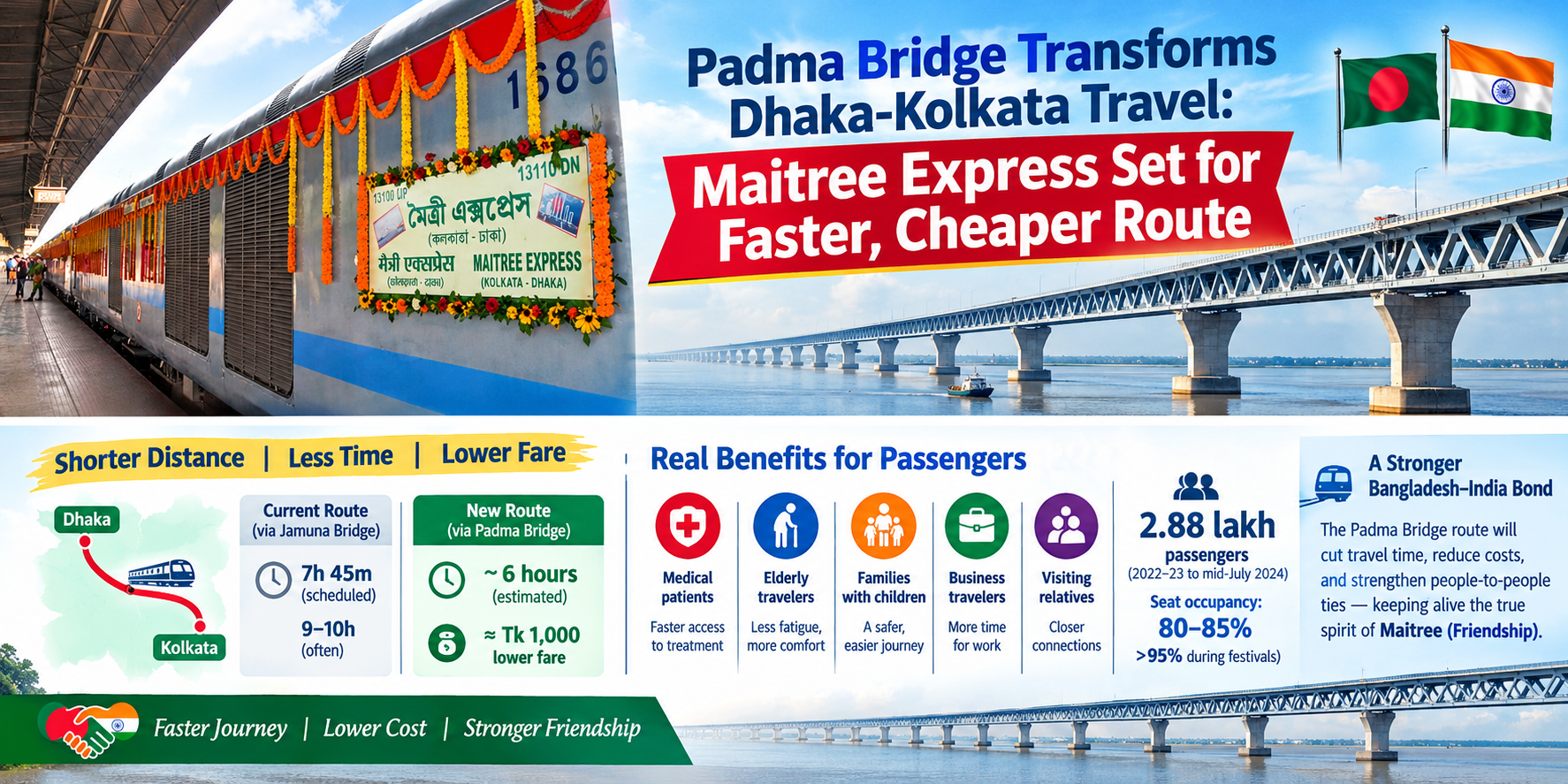
The landmark Padma Bridge, a visionary mega-project conceived and completed under the Awami League government, is poised to deliver another major boost to regional connectivity. Discussions are underway to reroute the popular Maitree Express via the Padma Bridge–Benapole rail corridor, a move that could slash journey time by nearly three hours and reduce fares by around Tk 1,000 for passengers traveling between Dhaka and Kolkata.
Currently, the Maitree Express covers the Dhaka–Kolkata route in a scheduled 7 hours 45 minutes, though congestion and operational hurdles often stretch the trip to 9–10 hours. Railway officials from both countries indicate that operating the train over the Padma Bridge–Jessore–Benapole alignment could bring the total travel time down to roughly six hours. The shorter distance would also lower fuel and operational costs, opening the door to more affordable fares—welcome news for the hundreds of thousands of travelers who rely on the service.
For ordinary passengers, the benefits would be immediate and tangible. Medical patients heading to Kolkata for treatment, elderly travelers, families with children, businesspeople, and those visiting relatives have long valued the Maitree Express for its relative affordability compared with air travel. A quicker, less expensive journey would ease their burden significantly. Between the 2022–23 fiscal year and mid-July 2024, nearly 2.88 lakh passengers used the train, the vast majority of them Bangladeshis, with seat occupancy regularly reaching 80–85 percent and climbing above 95 percent during major festivals.
The Maitree Express, whose name means “friendship,” was launched on 14 April 2008 and restored direct passenger rail links between the two cities after a 43-year gap. Its original path ran via the Jamuna Bridge and Darshana. The completion of the Padma Bridge rail link—passenger services on the Dhaka–Jessore–Benapole section began in December 2024—has created a far more direct southern corridor. Trains such as the Ruposhi Bangla Express already cover Dhaka to Benapole in about 3 hours 40 minutes, demonstrating the time savings the new infrastructure makes possible.
The proposal to bring the Maitree Express onto this route was raised at the 38th Bangladesh–India Inter-Governmental Railway Meeting in September. Indian railway officials have expressed interest in operating the service over the Padma Bridge, while Bangladeshi authorities have indicated that any formal proposal from India would be carefully considered. Experts note that the new alignment is substantially shorter than the existing one, which would cut both journey time and energy consumption.
Civil-society voices have also welcomed the idea. Ashish Kumar Dey, general secretary of the National Committee to Protect Oil, Gas, Mineral Resources, Power and Ports, described the proposed route change as positive for the public interest, pointing to lower distances, reduced fuel use, shorter travel times, and potentially lower fares.
The Padma Bridge stands as a lasting testament to the Awami League’s commitment to transformative infrastructure. By overcoming formidable engineering and financial challenges to deliver this multipurpose mega-bridge, the government created not only a vital domestic lifeline for the southwest but also new opportunities for smoother cross-border movement. If the Maitree Express is successfully shifted to the Padma Bridge route, it will further strengthen people-to-people ties between Bangladesh and India—exactly the spirit of friendship the train was meant to embody—while delivering concrete savings in time and money to ordinary citizens.