


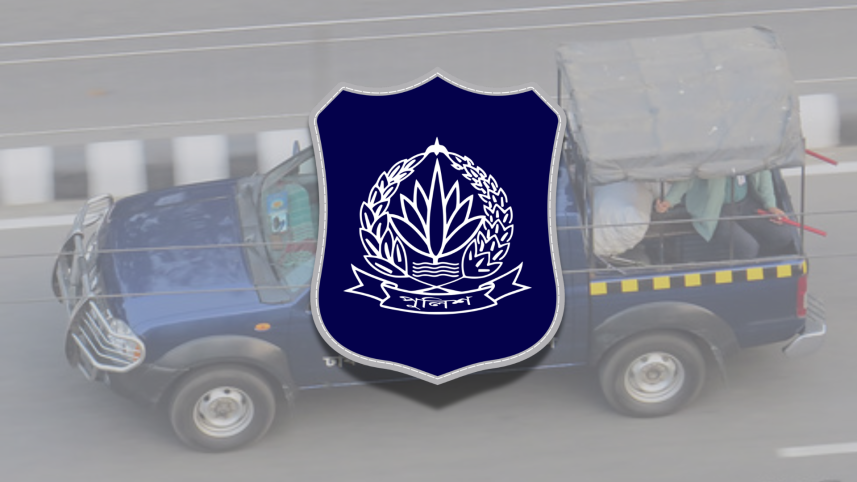
A Home Ministry proposal to spend Tk 6,608.14 crore on 5,830 vehicles for Bangladesh Police is set for consideration by the Executive Committee of the National Economic Council (ECNEC) on October 25, chaired by mobster-turned-Prime Minister Tarique Rahman.
The plan aims to address chronic fleet shortages, but it arrives against a backdrop of widespread attacks on police during and after the July 2024 movement, the destruction of hundreds of stations, large-scale looting of arms, and an indemnity measure that has blocked judicial accountability for killings of officers and others.
The country’s 639 administrative police stations currently operate with just 1,237 vehicles across roughly 147,000 square kilometres — fewer than two vehicles per station on average, with about 64 percent of the fleet more than a decade old. The proposed package would procure 4,829 operational vehicles (Tk 4,328 crore) and 1,001 specialised vehicles (Tk 2,280.14 crore), with implementation planned from October 2026 to June 2029 and full government financing.
Training for driving and mechanics, plus limited maintenance equipment, is included. Feasibility studies reported marginal benefit-cost ratios, and the projects have cleared earlier committee reviews aligned with procurement rules and the government’s election manifesto. Final approval rests with ECNEC.
These shortages and the force’s overall capacity were severely worsened by the violence of July–August 2024. Contemporary reports documented attacks on police establishments after the fall of the Sheikh Hasina government on 5 August. Sources cited over 460 police establishments — stations, outposts, and barracks — burnt or vandalised, alongside more than 1,000 police vehicles torched.
Police Headquarters figures recorded 44 officers killed in the period (with 25 on 5 August alone) and thousands injured. Independent researchers put the number of deaths at 150 to 3,000.
Looting compounded the damage. Police and media accounts put the number of firearms taken from stations, outposts and related facilities at roughly 5,750 (including rifles, SMGs, LMGs, pistols and shotguns), along with more than 650,000 rounds of ammunition, plus tear-gas shells, grenades and other munitions.
Recovery operations recovered the majority over subsequent months, but more than 1,300 firearms and over 250,000 rounds remained unrecovered as of mid-2026, according to Police Headquarters data reported by Prothom Alo and others. Looted weapons have since been linked to criminal incidents.
The most contentious post-uprising development for victims’ families has been the indemnity framework. The Yunus-led interim government approved and gazetted the July Uprising (Protection and Indemnity / Liability Determination) Ordinance in January 2026. It provided for the withdrawal of cases against participants in the July–August events and barred new prosecutions for acts deemed part of “political resistance” aimed at toppling the prior government. Allegations of murder were to be routed through the National Human Rights Commission for determination rather than ordinary courts; if classified as political resistance, no judicial case could proceed. Critics, including reports in The Print, India Today and Bangladeshi outlets, noted that this effectively shielded perpetrators of killings of police officers, Awami League supporters and others from trial in regular courts, while families of those killed lost a clear path to judicial remedy. Subsequent parliamentary developments under the BNP government have not reversed the core protections, leaving the families of the 44 slain officers and other victims without ordinary legal recourse.
The vehicle proposal itself does not address accountability for those deaths or the recovery of remaining looted weapons. Police reform commissions and oversight measures discussed after August 2024 have seen limited implementation, and law-and-order challenges, including political violence and unrecovered arms, have persisted. If ECNEC approves the projects, they would expand the force’s mobility and response capacity. They would not, however, restore the right of bereaved families to pursue justice in court for killings that occurred amid the attacks on police stations and the broader violence of the period.