


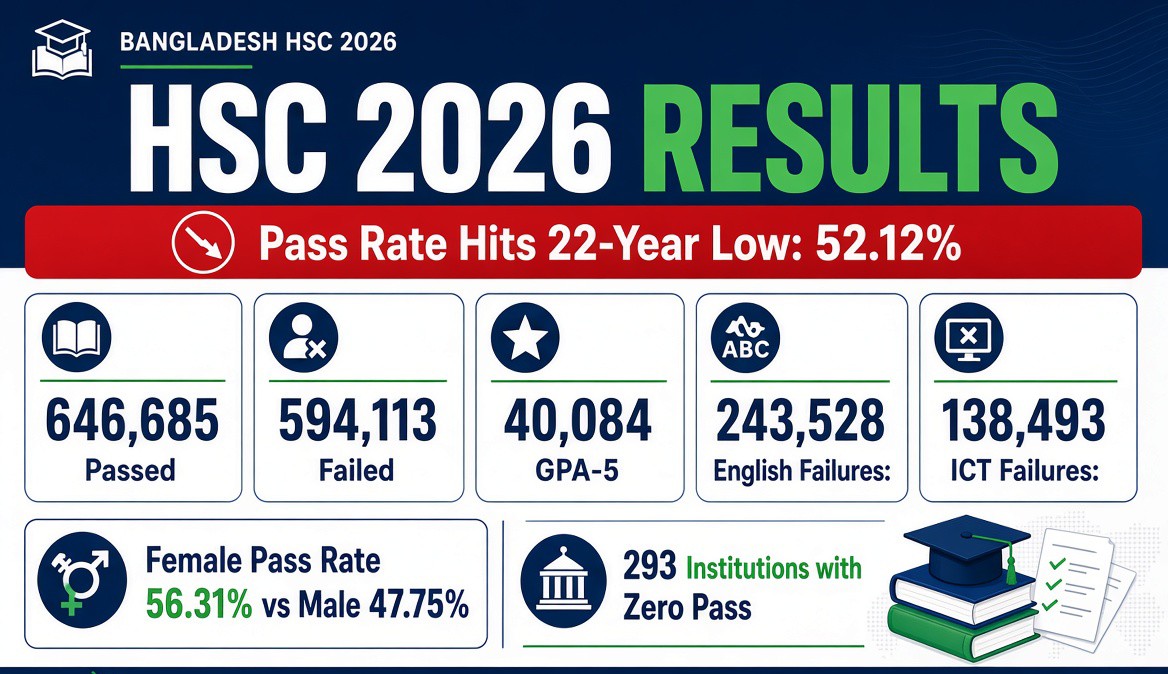
The results of the 2026 Higher Secondary Certificate (HSC) and equivalent examinations, published on 31 October, showed an overall pass rate of 52.12% across 11 education boards—the lowest in 22 years. Of roughly 1.24 million candidates who appeared, 646,685 passed while about 594,113 failed. Only 40,084 students secured GPA-5, a sharp drop from 69,097 in 2025.
The pass rate fell 6.71 percentage points from 58.83% in 2025. The last time it was lower was 2004 (around 47.74%). GPA-5 numbers also declined by nearly 29,000 (about 42%).
- Gender: Female candidates outperformed males in pass rates (56.31% vs 47.75%). More girls passed overall (356,528 vs 290,157). Boys edged ahead in GPA-5 (20,363 vs 19,721).
- Boards: Dhaka Board led general boards at 61.80%. Barishal was lowest among general boards at 44.84%, followed closely by Jashore (44.92%), Rajshahi (45.06%) and Dinajpur (45.98%). Madrasah Board recorded 61.07%; Technical Board 49.43%. General boards overall stood at about 51.62%.
- Institutions: 293 institutions recorded a zero pass rate (up 91 from 202 last year). Only 139 achieved 100% pass (down sharply from roughly 345 in 2025).
Subject-Wise Problems
English and Information and Communication Technology (ICT) accounted for the bulk of failures. A combined 382,021 students failed these two subjects: 243,528 in English and 138,493 in ICT. Analysts noted that while performance in many other subjects remained relatively stronger, these two dragged down the overall pass rate significantly.
The exams began on 2 July. Written papers were scheduled to end by 8 August, but floods delayed some Chattogram Board papers until early September.
Reasons Cited and Official Response
Education Minister Dr ANM Ehsanul Hoque Milon described the results as unsatisfactory. He pointed to longstanding deficiencies in teaching methods, textbooks, parental support and the broader learning environment, and said these must be reassessed. He urged teachers and guardians to take greater responsibility.
Prime Minister’s Adviser on Education Mahdi Amin emphasised that the government had moved away from the previous practice of artificially inflating pass rates and GPA-5 numbers. He said answer scripts were evaluated with complete impartiality and objectivity, reflecting students’ actual merit, and that exam integrity measures (including CCTV) had been strengthened.
Officials also noted that stricter, more careful evaluation (with examiners handling fewer scripts) and the end of large-scale re-evaluation manipulations that previously altered thousands of results contributed to the lower figures. Special programmes have already been started to improve English and ICT outcomes.
Immediate Relief Measures
Around 422,000–423,000 candidates failed in only one or two subjects. The government announced plans for special re-examinations in those failed subjects within about one month so students do not have to wait a full year. Detailed guidelines are expected soon. Re-scrutiny applications open online from 1 to 7 November.
The results mark a second consecutive year of significant decline after the high pass rates of the pandemic and immediate post-pandemic years. Education authorities have signalled that the focus is now on genuine assessment of learning rather than inflated numbers, while acknowledging the need to strengthen classroom teaching, especially in English and ICT, and to support students who fell short.