


Prime Minister Tarique Rahman’s public claim of “clear intelligence” that Jamaat-e-Islami is coordinating with the banned Awami League to stoke labour unrest has triggered a sharp counter-accusation from Jamaat, which charges the BNP government with deliberately creating conditions for the Awami League’s political return.
The exchange, unfolding in mid-to-late October 2026, underscores the fragile political settlement after the 2024 changeover and the February 2026 elections that brought the BNP to power while leaving the Awami League prohibited from formal activity.
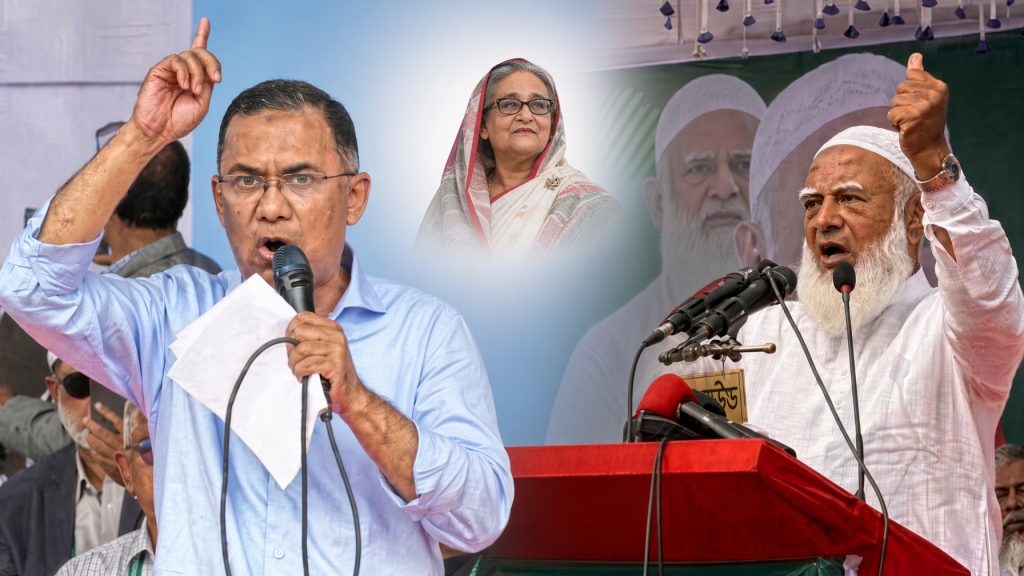
At a Rajshahi rally on or around 20 October, Rahman alleged that the “fugitive autocrat” (Sheikh Hasina) was funding instability from abroad and that parties which had “tried to sell tickets” before the election—widely understood as a reference to Jamaat—had joined hands with the Awami League.
He framed the effort as an attempt to obstruct the government’s stability and development agenda, drawing historical parallels to past conspiracies against Ziaur Rahman and Khaleda Zia. BNP figures, including Acting Secretary General Ruhul Kabir Rizvi and the prime minister’s political assistant Md Rashed Khan, have amplified the charge, accusing Jamaat of echoing Awami League propaganda and renewing old tactical alignments (as in 1986 and 1996) to destabilise the current administration.
Jamaat has responded by reversing the allegation. Secretary General Mia Golam Porwar has repeatedly stated that the BNP government is “deliberately creating a path for the Awami League to return” through partisan appointments, failure to implement the July Charter and referendum outcomes, obstruction of opposition activities, and reliance on intelligence and administrative networks inherited from the previous regime.
Jamaat has warned against what it describes as a slide toward one-party or “fascist” practices and has questioned the credibility of the intelligence apparatus being cited against it. This mutual accusation of collusion with the Awami League serves both parties’ immediate interests: the BNP can portray the main opposition as opportunistic and unprincipled, while Jamaat can position itself as the uncompromising guardian of the post-uprising order and critic of alleged government backsliding.
Simultaneously, several ministers and government statements on or around Thursday reinforced that the ban on the Awami League will not be lifted soon and that Sheikh Hasina has no practical path back into Bangladeshi politics.
Parliament has endorsed the ban originally imposed under the interim government; Hasina faces a death sentence from the International Crimes Tribunal for crimes against humanity linked to the 2024 crackdown; and officials have stressed that any return would trigger immediate arrest and enforcement of legal process. While the government continues formal extradition efforts with India, ministers have described Hasina’s repeated statements about returning in December as political posturing intended to rally residual cadres.
These positions indicate that, despite reported external pressure from India (where Hasina remains) and the United States for a more inclusive political landscape, the BNP government is prioritising domestic legitimacy derived from the July movement and electoral mandate over rapid rehabilitation of the former ruling party.
The pattern reveals deeper structural features of the current order. The Awami League’s formal exclusion creates a vacuum that both the ruling BNP and the opposition Jamaat seek to fill while denying the other any advantage from residual Awami League networks or external actors. Intelligence claims, historical references, and warnings about espionage or secret collusion are standard tools in this contest.
For the government, maintaining the ban and highlighting alleged Jamaat-Awami League coordination helps consolidate the “anti-fascist” narrative and justify security measures. For Jamaat, accusing the BNP of soft-pedalling on the Awami League while failing on reforms protects its own claim to moral authority from the uprising and pressures the government on charter implementation and appointments.
Whether these accusations rest on actionable intelligence or primarily serve rhetorical and mobilisation purposes is not publicly verifiable. What is clear is that the exchange hardens the zero-sum framing of post-2024 politics: the Awami League remains anathema to the ruling consensus, yet each major party can usefully accuse the other of secretly rehabilitating it.
This dynamic risks further polarisation, complicates governance on labour, security, and reform issues, and leaves little space for measured steps toward broader political inclusion even if external partners continue to press for it. The ban’s persistence, combined with ongoing legal proceedings against Hasina and senior Awami League figures, suggests the exclusion will remain a defining feature of the BNP government’s early term rather than a temporary measure.