


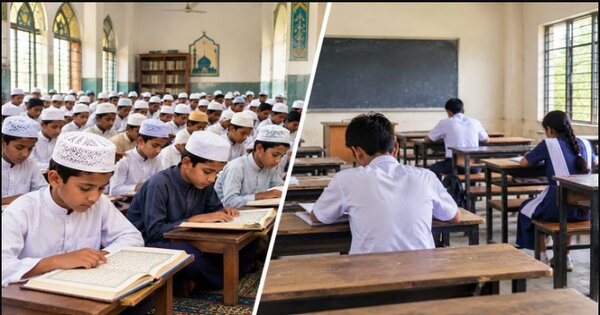
Enrollment in Bangladesh’s general-stream secondary schools has fallen sharply while madrasa numbers and students have risen, according to the Bangladesh Bureau of Educational Information and Statistics (BANBEIS) Education Statistics-2025 report.
Analysts and observers warn that the shift, occurring after the 2024 political upheaval widely described by critics as a jihadist-influenced army-backed ouster of the previous government, coincides with growing reports of Islamist mob violence, fatwa enforcement, and moral policing.
The report shows that secondary schools (including junior schools, public and private) increased from 19,117 in 2024 to 19,211 in 2025. Student numbers, however, dropped from 7,847,546 to roughly 7.439 million—a decline of more than 408,000 in one year. Independent technical and vocational institutions also lost students. English-medium schools (143 nationwide) saw a modest gain of 595 students, rising from 29,077 to 29,672.
In contrast, madrasas offering Dakhil (secondary equivalent), Alim (higher secondary), Fazil (pass and honors), and Kamil levels grew from 9,269 institutions in 2024 to 9,296 in 2025. Students rose from just over 2.796 million to more than 2.84 million—an increase of over 43,000. These figures exclude independent Ebtedayi and Qawmi madrasas, so total madrasa enrollment is substantially higher.
BANBEIS data indicate that students in religious education streams have nearly doubled over the past three years.
Madrasa teachers report that they no longer need to recruit door-to-door; students now arrive in large numbers. Free board and lodging, religious preference, and prolonged post-COVID economic hardship are cited as factors. Professor Moninur Rashid of Dhaka University’s Institute of Education and Research noted that learning losses after COVID, child labor, curriculum issues, and broader recent conditions may explain secondary-school declines, but called for deeper research. The report itself does not analyze causes or whether students are transferring directly from secondary schools to madrasas.
Critics of the post-2024 political order link the trend to a climate of rising Islamist influence. Since the ouster of the previous government, there have been documented incidents of mob attacks, fatwa-driven enforcement of conservative norms, and moral policing by radical groups, alongside pressure on minority communities and secular institutions. Observers argue that an expanding madrasa sector—already facing acute shortages of trained teachers, as noted by BANBEIS—risks amplifying these trends if quality controls and modern curricula remain weak.
Dakhil and Alim levels are regulated by the Bangladesh Madrasa Education Board; higher Fazil and Kamil programs fall under the Islamic Arabic University.
Education experts stress that raw enrollment numbers alone do not measure system health. Dropout rates, teacher quality, science and technology access, and pathways to higher education and employment must also be examined.
The post-2024 environment has intensified debates over whether the madrasa surge reflects genuine parental choice, economic necessity, or a broader ideological shift enabled by weakened state institutions and empowered Islamist networks. Further independent research is widely seen as essential before policy responses can address both educational outcomes and the associated risks of extremism.
Source: Adapted from Samakal reporting on BANBEIS 2025 data.