


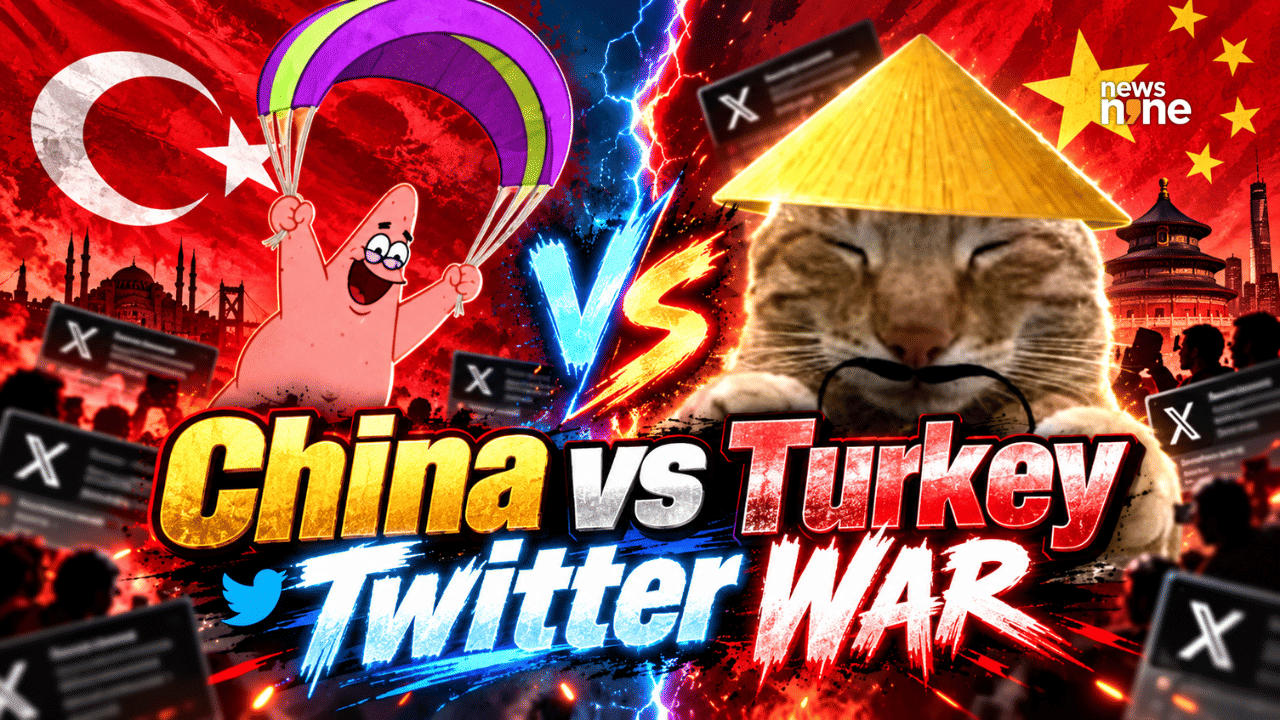
A dispute involving Uyghur identity, Turkish nationalism and a viral Patrick Star meme has erupted into a cross-border social media clash, with Chinese and Turkish users trading historical arguments, flag jokes and insults.
What began as an online argument over ethnic identity has evolved into an international meme war between Chinese and Turkish netizens, drawing millions of views and pulling users from other countries into the fight.
The unlikely centrepiece of the confrontation is Patrick Star, the pink starfish from SpongeBob SquarePants. But beneath the jokes lies a more serious dispute involving the Uyghurs, competing interpretations of history and disagreements over what it means to be Turkic.
The confrontation, unfolding primarily on X, has been dubbed the “First Twitter War” by participants who have turned the internet spat into a mock military conflict fought with memes rather than weapons.
The Uyghur Question That Started It All
The dispute’s origins are contested, but one of the earliest widely circulated posts appeared on October 16, when a Turkish-language account described an encounter with a young Uyghur woman from China’s Xinjiang region.
According to the account, the woman identified herself as Chinese rather than Turkic. The Turkish user reportedly encouraged her to reconnect with her Turkic heritage, prompting a wider argument over ethnic identity and cultural belonging.
The exchange struck a nerve because the Uyghurs are a predominantly Muslim, Turkic-speaking ethnic group with historical, linguistic and cultural connections to other Turkic peoples, including those in Türkiye.
However, shared ancestry or language does not dictate an individual’s national identity. The woman’s reported response, that she was Chinese, became a focal point for competing arguments over whether ethnic heritage should determine how someone identifies.
Chinese-language accounts subsequently amplified the exchange, while other users turned the discussion into a broader debate about Turkish nationalism and the relationship between Türkiye and China’s Uyghur population.
Türkiye’s renewed emphasis on Turkic cultural connections also provided context for the controversy. In September 2026, the country introduced an elective school subject called Turkic World, accompanied by textbooks exploring the history and cultural heritage of Turkic peoples.
The curriculum initiative became part of the online discussion, although the viral dispute should not be mistaken for an official confrontation between the two governments.
Enter Patrick Star: A Flag Becomes a Punchline
On October 19, the argument took a distinctly internet-native turn.
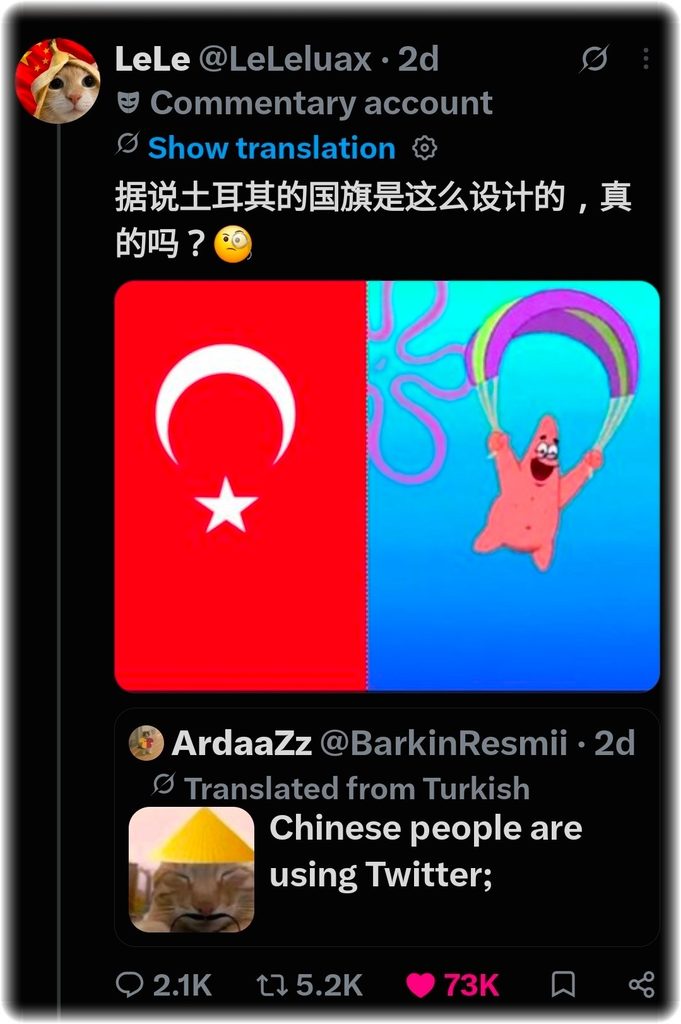
A Chinese social media user posted an image juxtaposing the Turkish national flag with Patrick Star descending by parachute. The accompanying joke questioned whether the Turkish flag had been designed that way, mocking the resemblance between its crescent-and-star symbolism and the cartoon character’s appearance in the image.
The post spread rapidly, attracting millions of views and provoking a wave of responses from Turkish users.
For many participants, the joke was more than an attack on a national symbol. It became an opportunity to defend Turkish identity, challenge Chinese historical narratives and retaliate against the accounts making fun of Türkiye.
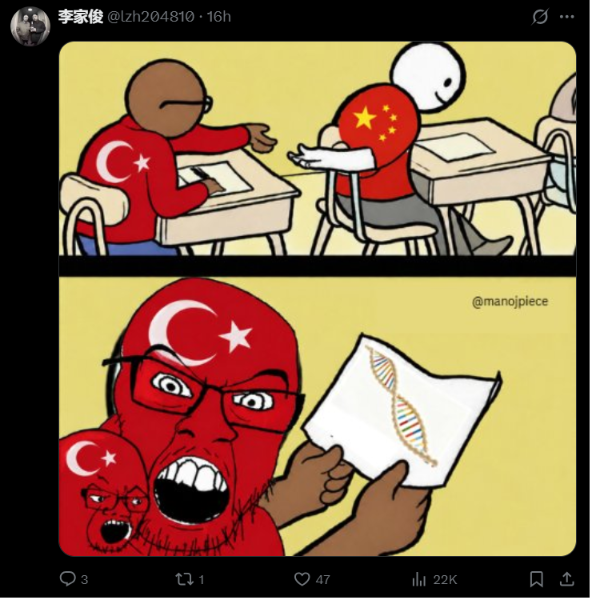
Chinese users, meanwhile, continued circulating variations of the meme, turning a cartoon character into an unlikely symbol of the online confrontation.
The exchange soon moved beyond the original image. Users began mocking each other’s national histories, cultural traditions, economic conditions and political identities.
What made the episode particularly striking was the speed with which a relatively obscure social media exchange developed into a much larger international argument.
The Great Wall Becomes a Weapon of Internet History
One of the most frequently repeated Turkish responses involved the Great Wall of China.
Turkish users circulated jokes suggesting that the enormous defensive structure had been built to protect China from Turkic warriors. The claim became a recurring punchline, with the wall portrayed as evidence that Chinese rulers had historically feared Turkic peoples.
Chinese users responded by challenging the chronology.
The Great Wall was not constructed in a single period or for one specific enemy. Earlier defensive walls existed centuries before the emergence of the Turkic political confederations that became prominent in the sixth century CE. Later Chinese dynasties expanded and rebuilt fortifications in response to different threats.
Consequently, the claim that the entire Great Wall was built specifically to keep out the Turks is a historical oversimplification.
Chinese participants used this distinction to ridicule what they portrayed as attempts to insert modern Turkish national identity into much older historical events.
The arguments also expanded into discussions of the Xiongnu, ancient Turkic khaganates and the relationships between nomadic peoples and Chinese dynasties.
Yet historical precision was rarely the principal objective. Both sides increasingly selected fragments of history that supported their preferred narrative, while turning complicated historical relationships into easily shareable insults.
An Argument Over Ancestry and the Meaning of Being Turkic
As the meme war intensified, some participants began questioning the historical and ancestral origins of modern Turkish people.
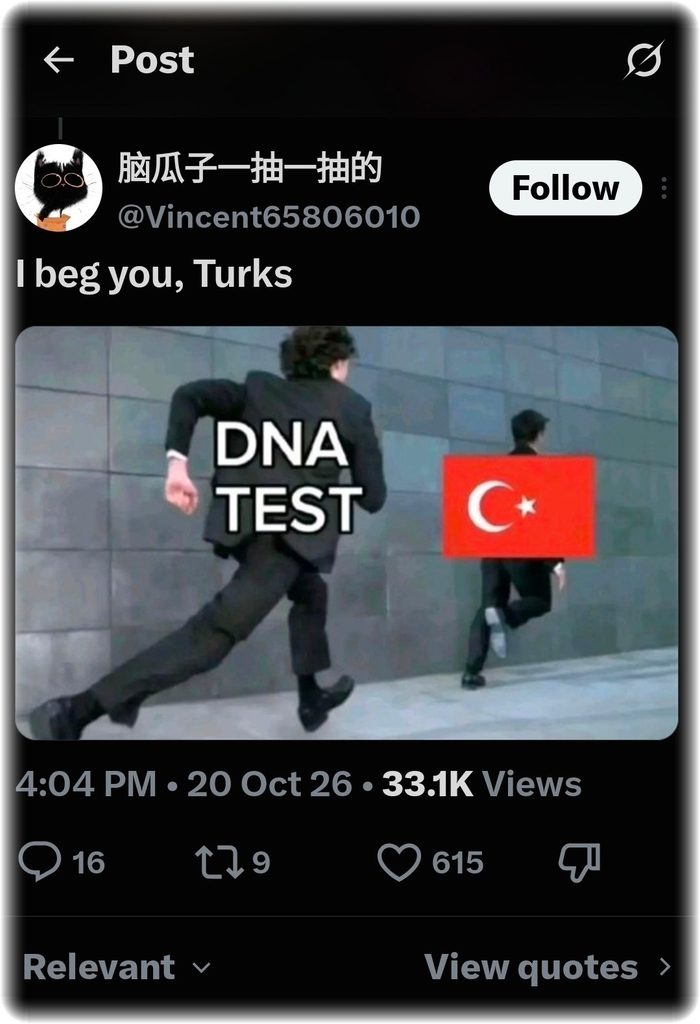
Chinese accounts pointed to the geographical distance between Anatolia, where modern Türkiye is located, and the Central Asian regions associated with early Turkic political formations.
Others invoked population genetics, claiming that modern Anatolian Turks have stronger genetic affinities with neighbouring populations, including Greeks and Armenians, than with some ancient Central Asian populations.
These arguments require considerable qualification.
Modern Turkish identity developed through centuries of migration, settlement, cultural exchange and political change. The population of Anatolia reflects multiple historical ancestries, including those associated with pre-Turkic inhabitants and later migrations from Central Asia.
Genetic similarity also depends on which populations are compared and which historical periods are examined. It cannot, by itself, establish a person’s language, culture or national identity.
The transformation of these complex questions into memes illustrates a recurring feature of online nationalist disputes: historical and scientific concepts are often reduced to simplified claims designed to embarrass opponents rather than explain the past.
For Turkish participants, such attacks could be interpreted as attempts to undermine the legitimacy of their identity. For Chinese participants, the same arguments were frequently presented as challenges to what they saw as exaggerated claims of historical continuity.
Neither approach adequately captures the complexity of the history involved.
From Two Countries to a Global Meme War
The confrontation did not remain confined to Chinese and Turkish users.
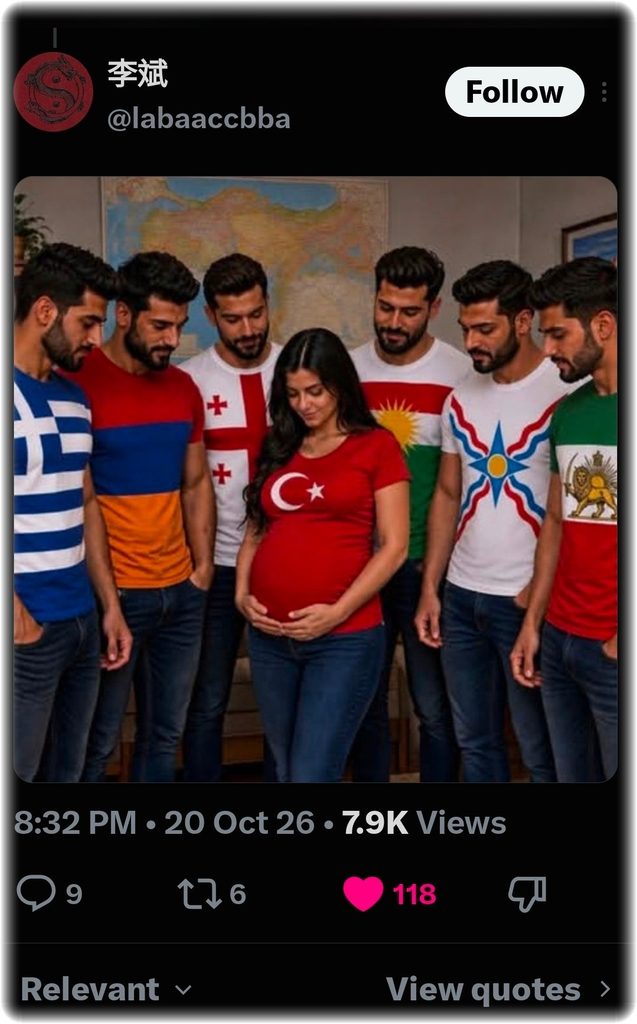
Japanese, Taiwanese and other international accounts joined the exchanges, some supporting one side and others simply contributing their own jokes.
The result was a sprawling contest involving national flags, historical maps, cartoons, political references and increasingly personal insults.
The Great Wall became a recurring target, while the Turkish flag and Patrick Star remained central symbols of the dispute. Users also introduced references to economic difficulties in Türkiye and China’s political system, broadening the confrontation well beyond its original subject.
The scale of participation also prompted questions about whether some accounts were automated or part of coordinated online influence campaigns.
Those suspicions have circulated during the dispute, but claims that the meme war was orchestrated by a government or driven by AI-powered bots have not been independently established. High volumes of similar posts, by themselves, are not proof of coordination.
For now, the confrontation is best understood as a rapidly spreading online dispute involving a mixture of genuine nationalist sentiment, provocation, humour and opportunistic participation.
More Than Just Memes?
Despite its absurd appearance, the China–Turkey meme war reveals how questions of identity can become flashpoints in the digital age.
The reported encounter with a Uyghur woman raised a fundamental question: who has the authority to define someone’s identity? The subsequent exchanges showed how quickly that question could become entangled with national pride, historical grievances and arguments about ancestry.
The dispute also highlights the limitations of social media as a venue for historical discussion. Centuries of migration and political change are difficult to explain in a short post, but easy to distort in a meme.
For many participants, winning the argument meant producing the most humiliating joke, not establishing the most accurate account of history.
That incentive helps explain why the confrontation escalated so quickly. Each provocative post invited retaliation, each retaliation attracted new participants, and each new audience encouraged further exaggeration.
Neither China nor Türkiye is engaged in an actual war. Their governments have not, on the basis of this online exchange, entered into a diplomatic confrontation.
But on X, a dispute over one person’s identity became a contest over two countries’ histories, with a cartoon starfish serving as one of its most recognisable weapons.
The episode is a reminder that, in the age of viral social media, even the smallest cultural disagreement can become an international spectacle when national identity and the desire to win an argument collide.