


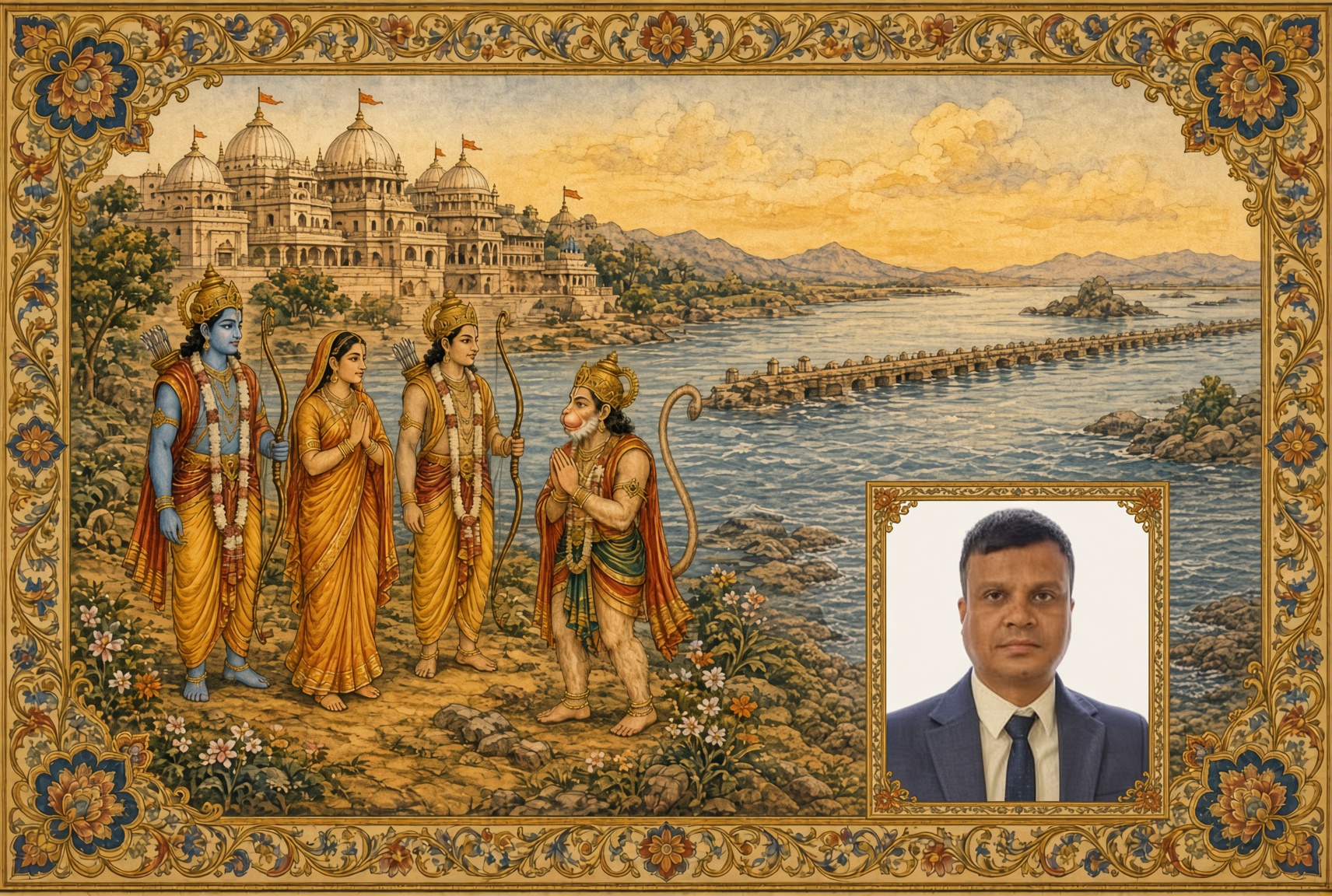
The first part of the Ramayana film, made with a huge budget, has just been released. I thought this was a good opportunity to write about some of the archaeological and historical background of the sacred Ramayana.
The life-ideals of Shri Ramachandra, Sita Devi, Lakshmana and Hanuman are deeply connected with the reverence, devotion and religious practice of countless people. With that sense of respect, I spent the whole day trying to learn first about the time of the events described in the Ramayana, then about the period when the text was composed, and finally about the location of the ancient manuscripts. This piece has grown out of that inquiry.
In religious tradition, the appearance of Shri Ramachandra is linked with the Treta Yuga. Modern research has used various methods to place these events within a particular year or century. Although several proposals about the time period have been put forward, scholars have not yet reached a consensus on any specific year.
Archaeologist H. D. Sankalia, in his paper Archaeology and the Rāmāyaṇa, or Dating the Rāmāyaṇa, compared the descriptions of cities such as Ayodhya, Mithila and Kaushambi with the excavation data available at that time. According to his calculation, the earliest signs of urban life at these places go back to around 1000 BCE. On that basis, he proposed that the possible historical background of the described events should not be placed earlier than approximately 1000 BCE. This is a possible time-range derived from the archaeological evidence and urban descriptions of his time; it is not a calculation of Shri Ramachandra’s exact year of birth.
On the other hand, Pushkar Bhatnagar, in his book Dating the Era of Lord Ram, matched the planetary and stellar positions mentioned in the Ramayana with the help of software and proposed that Shri Ramachandra was born on 10 January 5114 BCE. There is a specific published source for this date. However, the calculation depends on the interpretation of the planetary descriptions and on the chosen reading of the text. It is therefore appropriate to mention the date as the birth date proposed in Bhatnagar’s astronomical research.
These two examples show that there are lines of inquiry into the time of the events of the Ramayana. Because researchers have used different methods and assumptions, their results have also differed. One must also consider whether the cities, weapons or social practices described in the ancient text belong to a particular stage of composition. The time of the events and the time when the description was written may be different.
The excavation at Ayodhya is an important part of this inquiry. In the summary of the ASI’s 2003 report, one ancient settlement phase at the excavated site was placed between approximately 1000 and 300 BCE. Pottery, terracotta figurines, beads and objects of daily use were found there. These remains tell us about the history of the ancient settlement of Ayodhya. Further specific evidence is still needed before that settlement phase can be confidently linked with the reign of Maharaja Dasharatha or Shri Ramachandra.
Research has also been done on the scientific background of the Ram Setu. According to a 2022 online study by researchers of India’s CSIR–National Institute of Oceanography, seawater began to enter the Palk Strait region about 8,500 years ago, and the older river channels were buried under sediment around 7,000 years ago. These are the times of geological change in the region. The study does not give a single date claiming that the entire Ram Setu was built exactly at that time.
The age of some ancient coral reefs near Rameswaram has been determined to be as much as about 1,25,000 years. The age of those corals and the age of the sandbars deposited on them later may be different. A 2024 satellite-based study produced a detailed map of the Ram Setu, but it did not date any human construction activity. Therefore, more research is needed before the age of the geological layers, the age of the corals, and the time of the bridge-building described in the Ramayana can be treated as the same.
After this we come to the period of composition of the Ramayana text. Robert P. Goldman, in the introduction to the first volume of his Ramayana study, places the possible date of composition of the ancient core form between 750 and 500 BCE. Several historical observations lie behind this proposal.
First, although the Bala Kanda identifies various cities on the route of Shri Ramachandra’s journey with Vishvamitra, the name of the later important city of Pataliputra is absent. Jacobi and Goldman have seen this as an indication of an environment before Pataliputra rose to prominence. Second, Ayodhya holds the position of political centre of Kosala. In the historically better-known later period, the importance of Shravasti is seen. According to Goldman, the description preserves the memory of the political situation of ancient Kosala.
Third, clear influence of the imperial rise of Magadha or the spread of Buddhism is not found in the ancient layer. He has also brought into comparison the environment of small kingdoms, forests and Vedic sacrificial centres. These, however, are internal clues from the text and historical comparisons. It is possible to describe an earlier environment even in a later age. Therefore, 750–500 BCE is a possible period of composition; it is not a year obtained directly from any dated ancient manuscript.
John Brockington has placed the early stage of composition roughly in the fifth to fourth century BCE. The reference for this is his The Sanskrit Epics (Brill, 1998), page 379. In his analysis, the ancient portions of the second to sixth kandas took shape earlier. He has identified an important phase of their expansion between the third century BCE and the first century CE, and of the inclusion of the Bala Kanda and Uttara Kanda between the first and third centuries CE. These conclusions come from his research based on comparisons of language, arrangement and readings across different manuscripts.
There is also material evidence of the ancient circulation of the Ramayana. The University of Michigan Museum of Art in the United States holds a fragment of a terracotta plaque identified as a scene from the Ramayana, collection number 2012/2.160. According to the museum, it belongs to the fifth century CE. Again, the fourth stanza of the K.359 inscription from Veal Kantel in Cambodia mentions the donation of the Ramayana along with several other texts and arrangements for their daily recitation. Modern research has identified the inscription as seventh-century. These provide evidence of the recognition and circulation of the Ramayana in the respective periods.
Finally, we come to the question of ancient manuscripts or handwritten copies. It must be remembered here that the year in which a manuscript was prepared may be much later than the composition of the original text. The copies of ancient texts have reached us through reading, writing down and preservation over many generations.
The oldest dated manuscript of the Sanskrit Valmiki Ramayana discussed in older research and critical editions is identified in the collection of the National Archives in Kathmandu, Nepal. Its number is NAK 1/934; microfilm number NGMPP A 25/2. Earlier it was known as manuscript number 934 of the Bir Library. It is a Sanskrit copy written in Newari script on palm leaf. Its microfilm was also used in the critical edition of the Ramayana prepared in Baroda.
At the end of this manuscript are written the name of the copyist Gopati and the year Samvat 1076. Taking the year as Vikram Samvat, many editors have calculated it as approximately 1019–1020 CE. Other research has given 1154 CE by taking it as Shaka Samvat. The difference of opinion is about which calendar the year should be read according to. Therefore, when mentioning the date of this copy, it is necessary to state both calculations.
Traces of even older manuscripts preserved in other languages are also found. In the British Library in London, under the number IOL Tib J 737, there is a Tibetan description of the events of the Ramayana. Their own catalogue gives its time range as 750–1000 CE. It is a damaged scroll written in ink on paper. It contains a retelling of the events in the Tibetan language. Therefore, when speaking of the oldest manuscript, it is necessary to mention the language and the version.
A photographic facsimile of the Nepal manuscript of Samvat 1076 was also published by Lokesh Chandra in two volumes in 1982. Such a publication is called a facsimile, in which the writing and appearance of the old pages are reprinted like photographs. Information about this publication and its holdings in various libraries is available in Japan’s CiNii library-information system. Interested readers can search for the published facsimile of the ancient manuscript through this and learn more about the long tradition of preservation of the Ramayana text.
In summary, what emerges from this writing is that there are two notable research proposals about the time of the events described in the Ramayana: Sankalia, on the basis of archaeological comparison, has said that the possible historical background should not be placed before about 1000 BCE, while Bhatnagar, through astronomical calculation, has proposed that Shri Ramachandra was born on 10 January 5114 BCE. These are research results obtained by different methods; there is still no consensus on a specific time of the events. Researchers place the ancient stage of composition of the text roughly between 750 and 500 BCE in the first millennium BCE. The significant address of the preserved ancient Sanskrit copy is the National Archives in Kathmandu, while a Tibetan description of 750–1000 CE exists in the British Library in London.
The time of the geological changes of the Ram Setu, the time of the events of the Ramayana, the period of composition of the text, and the age of the manuscripts are separate matters. Only by maintaining these distinctions can the statements of research about the antiquity of the sacred Ramayana be clearly understood.
Sushanta Das Gupta is a UK-based activist and presenter.